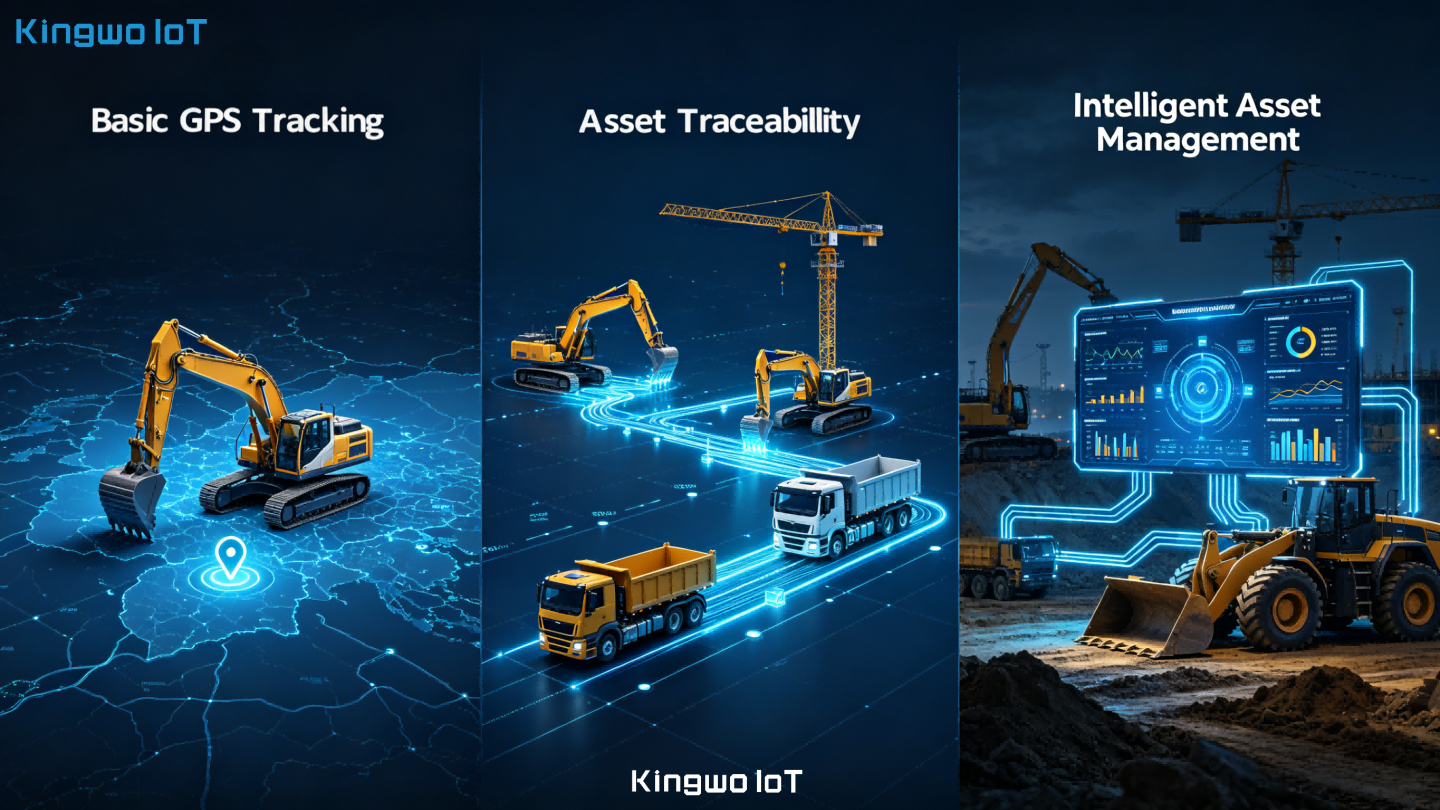

In asset-intensive industries such as construction, mining, and large-scale infrastructure development, heavy equipment represents one of the most significant capital investments. Individual machines often exceed tens or hundreds of thousands of dollars in value, while their operational efficiency directly impacts project timelines, cost structures, and overall profitability. Heavy equipment traceability enables companies to move beyond simple tracking toward full lifecycle asset visibility.
Traditionally, asset management strategies have relied on GPS-based tracking systems to monitor equipment location. While such systems have improved visibility, they remain fundamentally limited in their ability to support higher-level operational decision-making.
Recent developments in data-driven industrial systems suggest that the future of asset management lies not in tracking alone, but in the integration of tracking and traceability as a unified data infrastructure. This shift reflects a broader transformation across industries, where raw data is increasingly expected to support analysis, prediction, and control rather than simple observation. Heavy equipment traceability is becoming essential for managing complex and distributed industrial assets.
Conventional tracking systems are designed to answer a single question: where is the asset? While this capability is essential, it remains inherently limited in complex operational environments.
For heavy equipment operating across multiple sites or regions, location data alone cannot explain how assets are being used, whether they are functioning within expected parameters, or if underlying risks are developing. As highlighted in existing research, such systems often fail to capture the broader operational context required for effective management.
As a result, organizations frequently encounter persistent inefficiencies. Equipment may remain idle for extended periods, operate under suboptimal conditions, or experience preventable failures—all while appearing “visible” within tracking systems. This disconnect underscores a fundamental limitation: tracking provides awareness, but not understanding.
A more advanced framework emerges when tracking is extended into traceability. In industrial research, tracking and tracing are defined as complementary but distinct capabilities. Tracking refers to identifying an object's current state or location, whereas tracing focuses on reconstructing its historical states and transformations over time.
Traceability enables linking data across multiple stages, processes, and conditions, allowing the reconstruction of an asset’s lifecycle. Rather than viewing data as isolated points, this approach organizes information into a continuous and structured dataset, which forms the basis for deeper analysis and decision-making.
When applied to heavy equipment, this concept fundamentally changes how assets are perceived. Equipment is no longer treated as a static object to be located, but as a dynamic entity with a measurable operational history. This transition marks a shift from simple visibility toward contextual understanding.
One of the key contributions of traceability systems is the ability to structure asset data across multiple dimensions. Research in industrial traceability emphasizes the importance of capturing comprehensive contextual information—commonly described as the dimensions of who, what, when, where, and why.
Within the context of heavy equipment management, these dimensions can be interpreted as follows:
While each dimension provides partial insight, their integration enables a comprehensive representation of asset behaviour. This multidimensional perspective allows organizations to reconstruct usage patterns, detect inefficiencies, and identify abnormal operations with significantly greater precision.
In this sense, asset data evolves from passive monitoring information into a structured analytical resource.
The integration of tracking and traceability provides the foundation for data-driven asset management. As emphasized in the referenced research, the ultimate objective of traceability systems is not merely data collection, but the enablement of data-driven applications.
In heavy equipment operations, this capability translates into several practical outcomes. Organizations can analyze utilization patterns to optimize asset allocation, identify abnormal usage scenarios that may indicate risk, and leverage historical data to anticipate maintenance requirements. At the same time, centralized data visibility supports more informed planning and coordination across distributed operational environments.
These improvements demonstrate that the value of asset data lies not in its volume, but in its structure, continuity, and interpretability. With heavy equipment traceability, operational data becomes structured and actionable.
As asset data becomes more structured and interconnected, organizations are able to transition from visibility toward operational control. This concept extends beyond remote intervention, encompassing the ability to define expected operating conditions, detect deviations in real time, and respond proactively based on data insights.
This progression—from tracking to traceability, and ultimately to control—reflects a broader transformation in industrial asset management. Systems are no longer limited to observing assets; they are increasingly designed to support and guide operational decision-making processes.
In this evolving framework, data becomes an active component of the operational model rather than a passive record of events.
The implementation of a traceability-driven asset management approach requires the integration of multiple system components. These typically include data acquisition mechanisms, reliable connectivity across diverse environments, and centralized platforms capable of linking and analyzing asset data.
Such architectures align closely with established traceability system design principles, where the integration and continuity of data are essential for enabling downstream analytics and applications.
Without this system-level integration, data remains fragmented, limiting its usefulness and reducing its impact on operational outcomes.
The management of heavy equipment is undergoing a structural shift. While tracking has significantly improved asset visibility, it represents only the initial stage of a broader transformation. Traceability introduces the ability to reconstruct asset histories, contextualize operational data, and support advanced analytical applications.
In increasingly complex and distributed environments, the ability to interpret and act on asset data will become a defining factor in operational performance. Organizations that move beyond tracking and adopt traceability-driven approaches will be better positioned to optimize resource utilization, reduce risk, and enhance decision-making capabilities.
Ultimately, the future of asset management will not be defined by knowing where assets are, but by understanding how they operate—and what actions should follow.
Within this broader shift from tracking to traceability, the role of technology providers is also evolving. Solutions are no longer evaluated solely based on positioning accuracy or device performance, but on their ability to support structured data integration and operational decision-making.
From this perspective, effective asset management systems require more than isolated hardware capabilities. They depend on the coordinated interaction between data acquisition, connectivity, and platform-level intelligence, forming a continuous data loop from field operations to centralized analysis.
At Kingwo, this approach is reflected in the integration of multi-mode positioning technologies, sensor-based data collection, and cloud-based management platforms. Rather than focusing on location visibility alone, the emphasis is placed on enabling a more comprehensive understanding of asset behaviour across different operational environments.
This includes the ability to capture and structure asset data across time, usage, and condition, supporting applications such as utilization analysis, anomaly detection, and maintenance planning. By aligning device-level data with platform-level analytics, asset information becomes more than a record—it becomes a functional input for operational strategy.
As industries continue to move toward data-driven operations, the value of asset tracking solutions will increasingly depend on their capacity to evolve into traceability-oriented systems. In this context, the focus is not on adding complexity, but on enabling clarity—transforming fragmented data into actionable insight.
Wessel, J., Turetskyy, A., Wojahn, O., Herrmann, C., & Thiede, S. (2020). Tracking and Tracing for Data Mining Application in the Lithium-ion Battery Production. Procedia CIRP, 93, 162–167.
By Kailiang Tang
Acting Marketing Director, Kingwo IoT
 news
news
 news
news
 news
news
 news
news
 news
news
 news
news
 news
news
 news
news

English

French

Portuguese

Spanish