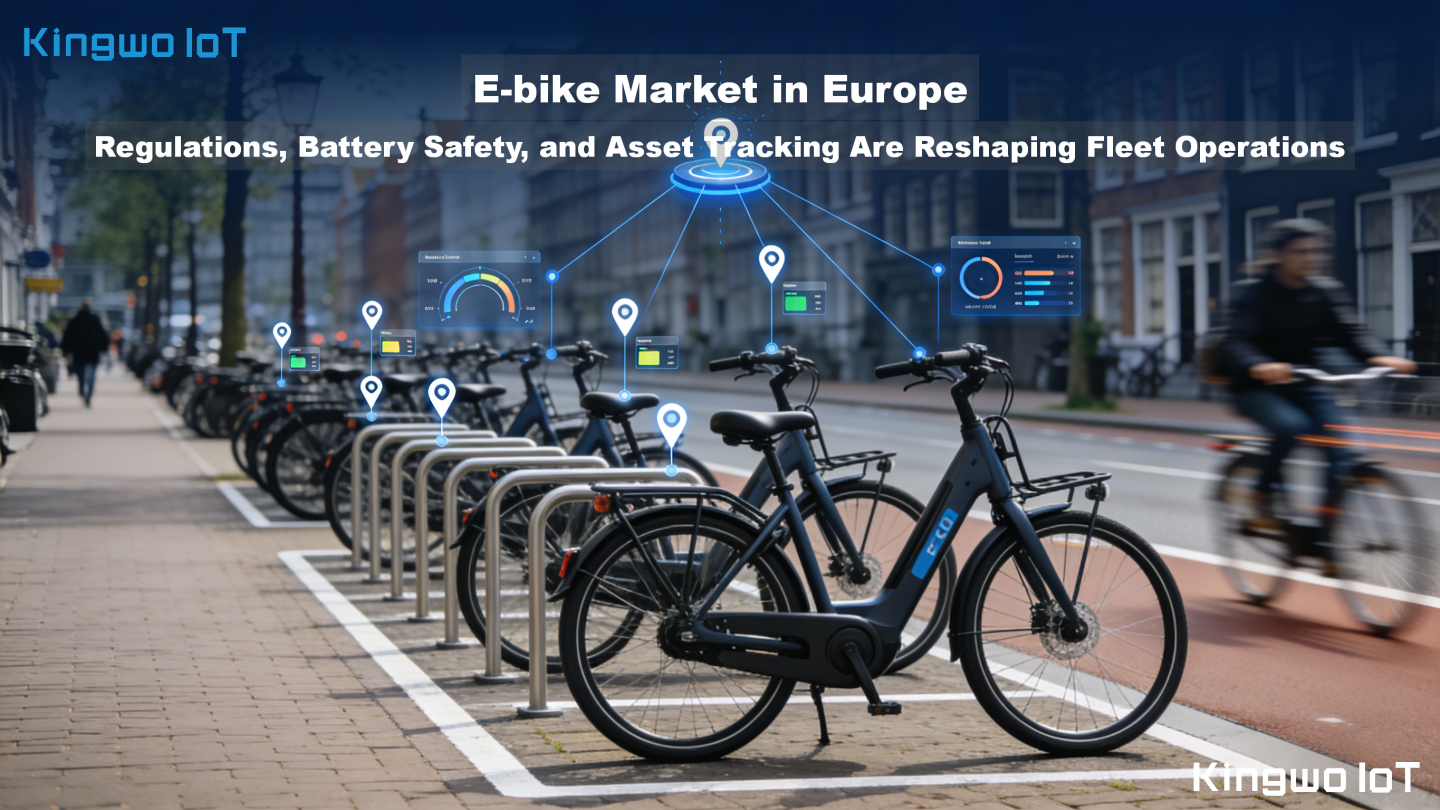

The European e-bike market is entering a new stage of maturity.
After several years of rapid expansion driven by consumer adoption and urban mobility trends, growth is no longer the only defining feature of the market. Instead, the focus is shifting toward structure, regulation, and operational efficiency. As e-bikes become increasingly embedded in logistics networks, shared mobility systems, and corporate fleets, the complexity of managing these assets has grown significantly.
This transition is redefining how businesses approach e-bike deployment across Europe. The conversation is no longer centered on how many units can be deployed, but rather on how these assets can be managed, optimized, and sustained over time.
Businesses need reliable e-bike tracking solutions that provide:
In urban environments such as Amsterdam, Berlin, and Paris—where e-bike adoption is high—asset loss and misuse have become key concerns.
As a result, GPS tracking for e-bike fleets and IoT-based asset tracking systems are becoming essential components of modern fleet management strategies.
Across the European Union, regulatory developments are beginning to influence not only product design, but also operational practices.
The European Commission has introduced a new generation of battery regulations designed to improve sustainability, safety, and lifecycle transparency. These frameworks place increasing emphasis on traceability, responsible recycling, and long-term environmental impact. As part of this broader direction, battery passport systems are expected to be implemented in the coming years, particularly for light mobility batteries such as those used in e-bikes.
Although these policies are often discussed in the context of manufacturing and supply chains, their implications extend much further. Businesses operating e-bike fleets are gradually being drawn into a regulatory environment where compliance is no longer confined to production but becomes part of daily operations.
In parallel, industry organizations such as CONEBI continue to highlight the need for consistent standards across the European market, reinforcing the idea that fragmented approaches to safety and sustainability will become increasingly difficult to maintain.
At the same time, European cities are taking a more active role in shaping how e-bike fleets operate within urban environments.
Cities such as Amsterdam, Paris, and Berlin have adopted or tested shared-mobility management tools, including geofencing, designated parking arrangements, and data-sharing or data-supported planning mechanisms. These measures are often implemented at the city level rather than as uniform national regulations, but they reflect a broader shift toward more structured and data-informed urban mobility governance.
For fleet operators, this introduces a new layer of operational complexity. Instead of operating in a uniform regulatory environment, companies must now navigate a patchwork of city-level requirements, each with its own expectations around deployment, parking, and asset distribution.
This evolution signals a deeper transformation: urban mobility is no longer purely physical infrastructure—it is increasingly digital, governed by data, and continuously optimized.
While consumer ownership remains an important part of the market, the growth of e-bikes in Europe is increasingly driven by commercial use cases.
Last-mile delivery services, rental platforms, and shared mobility operators are expanding their fleets across major cities. In these scenarios, e-bikes are no longer personal mobility devices; they are operational assets that must be managed, maintained, and monitored across distributed networks.
This shift introduces new challenges. Fleet operators must deal with asset dispersion, inconsistent usage patterns, and varying environmental conditions. The scale of operations also amplifies risks, including asset loss, inefficient utilization, and operational downtime.
As a result, the management of e-bike fleets is becoming more closely aligned with broader asset-tracking and fleet-management strategies that have long been used in the logistics and transportation sectors.
In this evolving landscape, asset visibility is emerging as a foundational capability rather than a competitive advantage.
Operators increasingly require a clear understanding of where their assets are, how they are being used, and whether they are performing as expected. This need is particularly pronounced in dense urban markets, where high utilization rates and elevated theft risks create additional pressure on operational efficiency.
The demand for reliable e-bike tracking solutions is therefore growing. Technologies that combine multi-source positioning, real-time connectivity, and platform-based data analysis are enabling businesses to move beyond basic location tracking toward a more comprehensive view of asset performance.
This shift reflects a broader change in mindset. The question is no longer simply about tracking an asset, but about understanding its role within a larger operational system.
Alongside regulatory and operational changes, battery safety has become a critical concern across the European e-bike market.
Recent coverage from Euronews and other media outlets has highlighted a growing number of incidents involving battery-related risks, including fires linked to improper charging practices or non-compliant components. These developments have increased public awareness and placed additional pressure on operators to ensure safety across their fleets.
For businesses, this means that battery management is no longer a background technical issue. It is becoming an integral part of operational strategy, requiring greater visibility into asset conditions and faster response capabilities in the event of anomalies.
The integration of data-driven insights into fleet operations is therefore not only about efficiency, but also about risk mitigation.
The technological approach to e-bike management is also evolving.
In earlier stages of the market, tracking solutions were often deployed as standalone tools designed to provide basic location data. Today, however, businesses are increasingly adopting integrated systems that combine connectivity, data processing, and platform-based management.
These systems enable a more holistic approach to fleet operations. By linking devices to centralized platforms, operators can gain insights into usage patterns, identify inefficiencies, and respond more effectively to operational challenges.
This transformation marks a shift from isolated technologies to interconnected ecosystems, where data plays a central role in decision-making.
The European e-bike market is moving toward a more structured, regulated, and data-driven future.
As regulatory frameworks evolve, urban mobility systems become more sophisticated, and commercial applications continue to expand, businesses must adapt to a new set of expectations. The ability to manage assets effectively, ensure operational safety, and respond to dynamic environments will become critical success factors.
In this context, solutions that combine asset tracking, real-time connectivity, and intelligent data analysis are likely to play an increasingly important role.
The future of e-bike operations in Europe will not be defined solely by growth, but by how effectively that growth is managed.
 news
news
 news
news
 news
news
 news
news
 news
news
 news
news
 news
news
 news
news
 news
news

English

French

Portuguese

Spanish