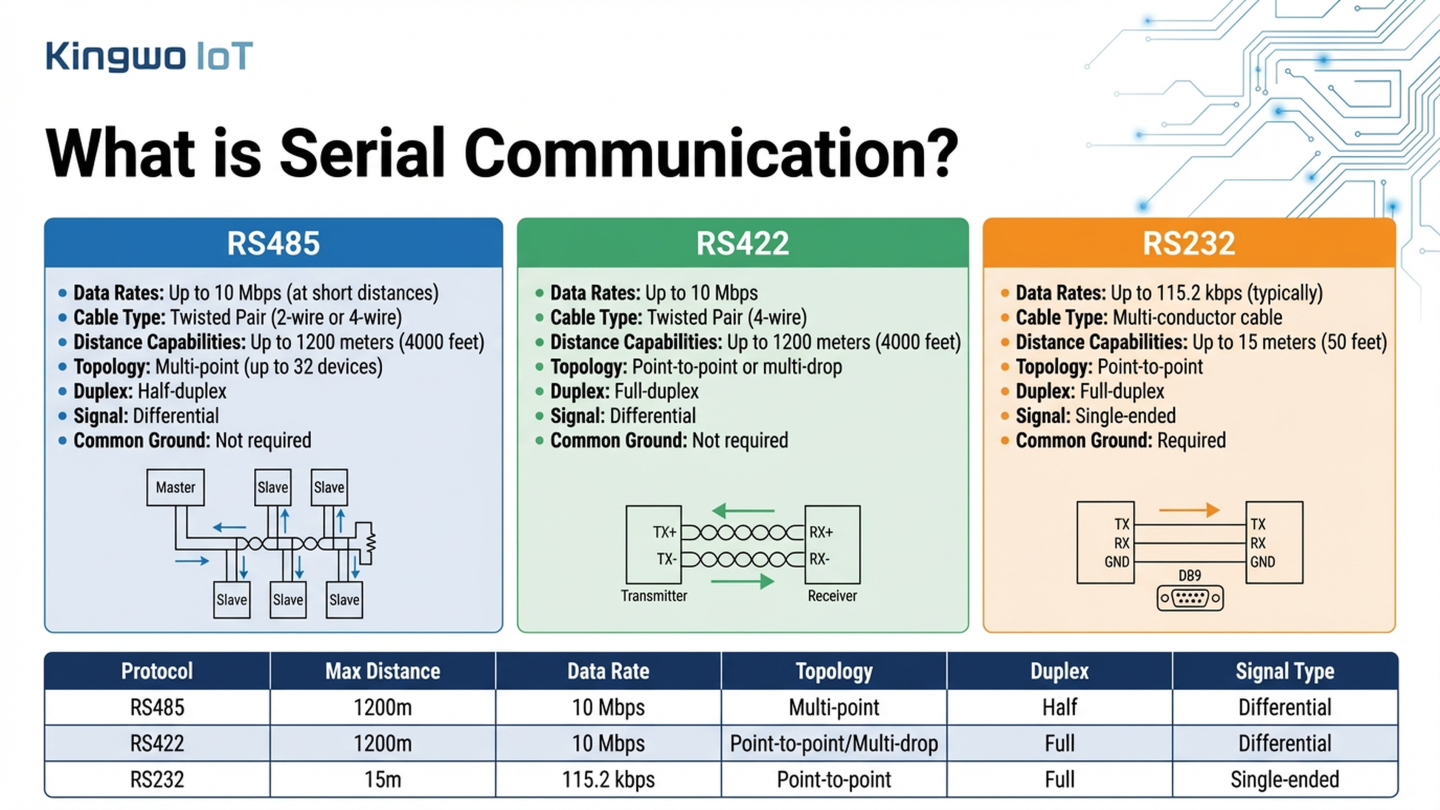

Serial communication is one of the most fundamental building blocks in industrial automation, IoT device connectivity, fleet telematics, asset monitoring, and embedded system design. Despite the rise of wireless protocols such as 𝐋𝐓𝐄-𝐌, 𝐍𝐁-𝐈𝐨𝐓, 𝐋𝐨𝐑𝐚𝐖𝐀𝐍, 𝐚𝐧𝐝 𝐖𝐢-𝐅𝐢, serial interfaces remain indispensable because of their stability, cost efficiency, and long-term reliability.
This article explains what serial communication is, explores the differences between #𝐑𝐒𝟐𝟑𝟐, #𝐑𝐒𝟒𝟐𝟐, #𝐑𝐒𝟒𝟖𝟓, and #𝐂𝐀𝐍𝐁𝐔𝐒, and finally analyzes—through Kingwo IoT's engineering perspective—why RS485 continues to be the preferred choice for modern IoT hardware and industrial communication systems
Serial communication transmits data bit by bit over a communication line. Compared to parallel communication, serial communication:
Because of these benefits, serial interfaces are widely used in smart logistics, industrial automation, energy monitoring, smart agriculture, fleet management, building management systems (BMS), and machine-to-machine (M2M) communication.

1. RS232: Traditional but Limited
RS232 is one of the earliest serial standards used in computers and industrial devices. It is simple but has notable limitations:
RS232 is still used for console interfaces and legacy equipment but is not suitable for modern, large-scale IoT networks.
2. RS422: Improved Stability with Limited Scalability
RS422 introduced differential signaling, enabling:
However, its multi-drop capability is limited, and the wiring complexity makes it less favored for scalable deployments.
3. RS485: The Industry Standard for IoT and Industrial Networks
RS485 is currently the most widely adopted serial interface in industrial and IoT environments. Its advantages make it the default choice for sensors, meters, telematics terminals, industrial controllers, and environmental monitoring systems.
Key advantages of RS485 include:
RS485 has become a critical technology for:
A common misconception is that RS485 and CAN Bus are competing "protocols." In reality:
Characteristics of Serial (RS) Communication:
Characteristics of CAN Bus:
Comparison Table

Conclusion: RS485 offers the best balance of cost, distance, flexibility, and industrial compatibility, making it ideal for large-scale IoT deployments.
At Kingwo IoT, RS485 is widely integrated into smart logistics devices, asset tracking units, industrial sensors, and energy monitoring systems. through extensive global deployments, RS485 has proven to deliver unmatched value in real-world IoT conditions.
1. Exceptional Stability in Harsh Industrial Environments
Kingwo IoT devices operate in environments such as:
In these scenarios, RS485's differential signal design ensures consistent, accurate data transmission—critical for real-time monitoring and operational safety.
2. Cost Efficiency for Large-Scale IoT Deployments
IoT projects often involve hundreds or thousands of devices. RS485 provides significant benefits:
This enables Kingwo IoT to deliver competitive, scalable IoT solutions without compromising performance.
3. Multi-Node Networking for Rich Sensor Connectivity
RS485 allows multiple sensors and sub-devices to connect in a single network, such as:
This makes it ideal for telematics systems that require integrated data from multiple inputs.
4. Full Compatibility with Industrial Protocols
Kingwo IoT devices often use Modbus RTU over RS485, a globally recognized standard for industrial data exchange.
Advantages include:
This ensures seamless integration with logistics systems, ERP platforms, and industrial control systems.

Although IoT communication technologies continue to evolve, RS485 remains essential because it delivers a unique combination of reliability, cost efficiency, scalability, and industrial compatibility.
For Kingwo IoT, RS485 has proven to be a robust foundation for building intelligent telematics devices, industrial monitoring systems, and data-driven logistics solutions. As global industries move toward greater automation and digital transformation, RS485 will continue to play a vital role in connecting sensors, equipment, and cloud platforms—ensuring stable operations in the world's most demanding environments.
 news
news
 news
news
 news
news
 news
news
 news
news
 news
news
 news
news
 news
news
 news
news

English

French

Portuguese

Spanish