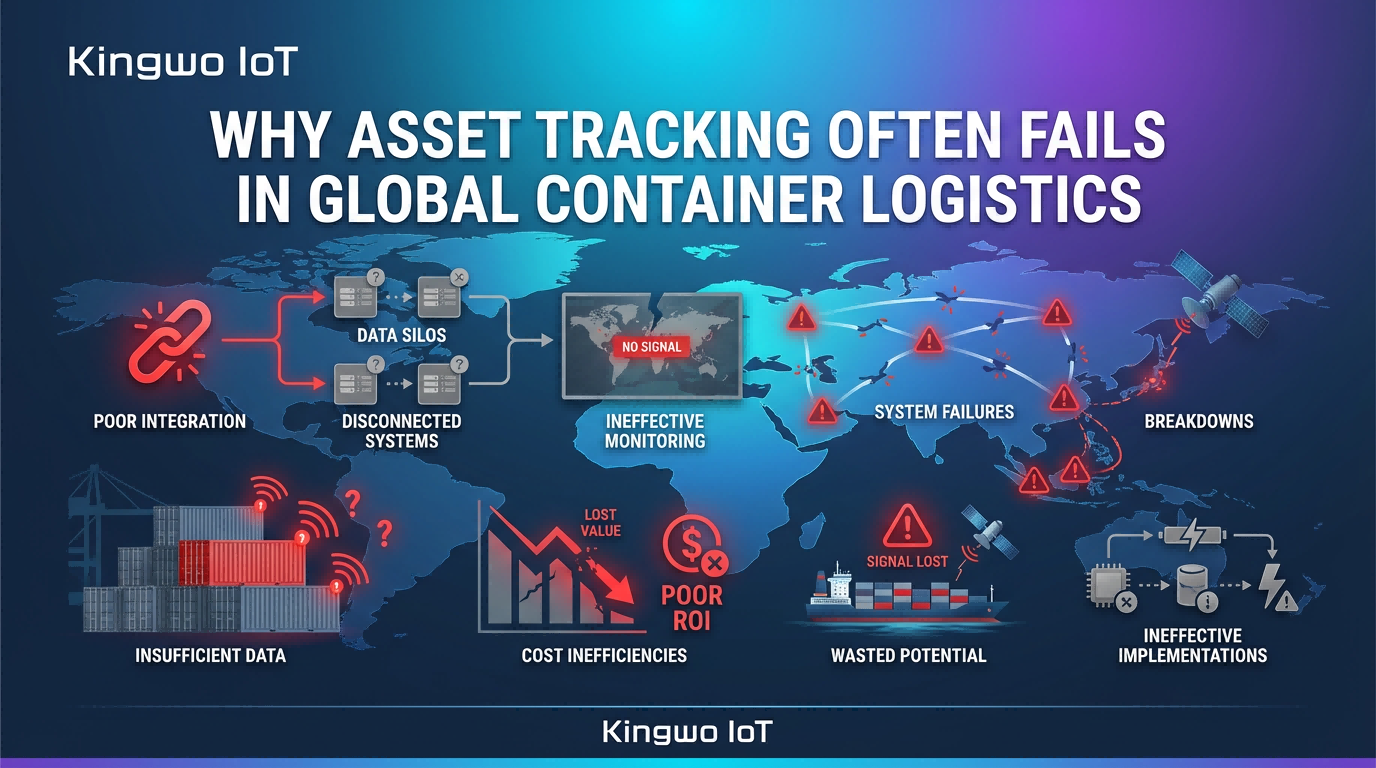

Container logistics has exploded in scale and complexity, yet asset tracking in container logistics has failed to keep pace with end-to-end visibility demands. In modern supply chains, millions of shipping containers circulate across continents—through congested ports, sprawling rail yards, and remote depots—often passing through multiple networks and jurisdictions. As one industry analyst warns, this globalized asset circulation and decentralized operation environment has created a “growing gap” between where containers should be and where they can be confirmed to be. In other words, trucks and cranes move faster and farther than ever, but our tracking systems, built for simpler times, cannot reliably follow. Many companies discover only after the fact that a container is missing or delayed. This lag – silent and invisible – turns small data gaps into cascading operational risks: missed deliveries, excess idle inventory, detention fees, even insurance disputes.
Several structural blind spots lie baked into today’s container-tracking solutions. Firstly, most trackers were originally designed for powered vehicles (trucks, vans) with easy access to electricity and good GPS skies. Shipping containers, by contrast, are long-lived, often parked for months, and crammed into dense metal stacks. Kingwo’s analysis finds that legacy vehicle trackers introduce “frequent battery replacement requirements, dependence on continuous power sources, [and] poor performance in enclosed or metal-dense environments” when applied to containers. In practice this means many trackers deplete their batteries or lose lock while sitting idle or in a port pileup, and they simply stop reporting.
Moreover, in a lean-staffed industry, asset data is often under-monitored. With fewer personnel overseeing larger fleets, a dead tracker is easily overlooked until a critical event (like a shipment arriving late) exposes the gap. Few systems issue an alert when a tracker goes dark; instead, the container quietly disappears from the digital map and only resurfaces during audits or manual yard checks. In short, failures tend to be silent – no red light flashes, just months of blind spots until a customer complains or a partner flags a mismatch.
Connectivity dropout is a perennial culprit. LTE or satellite signal that carries a container’s location can vanish behind stacks of steel, inside tunnels, or on a crowded vessel deck. As one IoT expert notes, “at sea or on rail, radio connectivity may disappear for days,” so trackers must focus on “clean departure, clean arrival and occasional audit points if a handoff window is missed”. In practice, that means pure GPS or cellular lock often fails: containers often spend long legs of their journey in dead zones. Kingwo emphasizes hybrid positioning for this reason, combining GNSS with cellular location and even Wi-Fi probes so that a container isn’t entirely blind when one source drops out.
Network handoffs across borders further undermine signals. A container moving from one country’s 4G carrier to another’s may lose low-power modes or encounter different bandwidth restrictions. For instance, some carriers don’t support power-saving features (PSM/eDRX) or even text messages for check-ins, so a tracker expecting a fallback can misfire. In Asia-Pacific especially, infrastructure is patchy: rural ports and inland depots “lack reliable infrastructure,” restricting real-time data transmission and making remote tracking “difficult”. Similarly, fleets in Latin America often span regions with spotty cellular coverage, forcing some operators to resort to satellite links just to get occasional pings. Even in North America and Europe, changing carriers or switching bands can leave a device momentarily unplugged from the network.
The practical effect is device dropout: trackers stop sending for hours or days. Without a persistent backup connection, ships and trains become “black holes” on the map. One container might vanish during an ocean voyage and only reappear when it reaches port weeks later – by then too late to correct the lost segment. The familiar user interface of a mapping app can lull managers into thinking “no news is good news,” even while thousands of trackers are silently offline. As an Onomondo case study puts it, “Without real-time visibility … companies experience blind spots, resulting in delays and costly inefficiencies”.
Battery life is equally critical. Traditional trackers require frequent charging or replacement batteries – a non-starter for months-long voyages. Every maintenance visit costs labor and schedule disruption, often far more than the device itself. Kingwo points out that in distributed container operations, “the cost of replacing or recharging batteries often exceeds the cost of the device”. In practice, trackers that ping every hour will burn through batteries rapidly. For example, the engineer of a multi-year-tracking project warns that even a small increase in polling (like “periodic polling just in case”) can turn into a “battery line everyone regrets”. The result is silent death: a tracker’s battery drains mid-voyage, but the system assumes it simply has no new updates, not realizing it has failed.
Real-world ops amplify the problem. Containers often sit waiting for days at ports or depots. If a tracker wakes every few hours to record location (or worse, to scan GNSS satellites inside a metal yard), its battery will not last the detention period. The smarter design trend therefore uses deep sleep and motion-based wake-ups: device sleeps most of the day and only updates on trips or exits. Absent such discipline, even the best coverage is irrelevant if devices go flat silently.
When containers aren’t on the move, they often become invisible. Idle boxes at inland yards or off-terminal locations are a huge untapped asset pool. Fleets commonly overlook containers “that sit empty for extended periods” – either forgotten by carriers or used for (unpaid) storage. Without persistent tracking, these idle containers accrue rent/detention costs or get double-booked. Geoforce bluntly observes that when you rely on “non-powered equipment tracking,” “waste creeps in”: crews spend hours hunting for missing trailers or containers, only to discover they were already sitting unseen in a yard. Even when a tracker is installed, if it sleeps deeply during dormancy (as it should), operations need another mechanism to call it to attention. Sadly, most systems lack yard-check alerts or heartbeat monitors. A device simply stops sending data, and everyone assumes “it’s parked somewhere.” Only when another part of the chain (eg. a terminal RFID scan or an owner’s inventory query) notices a missing container does the gap become obvious.
In practice, these invisible containers are a double-threat: they drive up costs and erode trust. For example, a customer expecting timely pickups may instead find no record of a container’s presence, yet incur hefty fees when it’s finally returned late. Data scientists report that poor visibility in logistics “directly harms operations” for 94% of companies. The victims: yards full of “forgotten assets” quietly leaking value, while managers wring their hands over missing updates.
Hardware issues also undermine tracking. The mounting location and method can make or break a solution. Magnets are popular for easy installation, but as one IoT designer warns, steel can be “friend (attachment) and foe (signal shadow)”. Many trackers are hidden beneath a frame rail or inside an enclosure to be unobtrusive, but such “beautiful but blind placements” often fall silent – the metal body shields the GPS antenna or blocks cellular signals. Similarly, the harsh conditions of container logistics – salt spray on ocean decks, jet sprays in ports, extreme temperatures – can defeat ratings: a device may be IP68 but still short out under a pressure washer or freeze in a cold storage yard.
Vibration and tampering are another concern. Containers and chassis rattle constantly; a loosely mounted tracker can shake free. To address this, experts recommend combining magnets with at least one screw for high-vibration assets. Yet too often, trackers are merely strapped on and forgotten. In tropical regions, long yard parking exposes devices to theft or unauthorized removal – and unless a tracker is intentionally “tamper-aware,” its sudden disappearance goes unrecorded. Kingwo and others stress that robust designs must include anti-tamper brackets or built-in accelerometers/light sensors to flag when a container is being lifted or opened unexpectedly. Without those, even a working tracker can fail silently by being ripped off.
On the software side, many tracking projects fail at the dashboard. Collected location data often ends up in stand-alone portals that don’t mesh with everyday ops systems (TMS, ERP, yard management). As one reviewer notes, a common pitfall is “poor integration with existing business systems” and solutions that “can’t scale with growth”. In plain terms, this means dispatchers and warehouse staff don’t see the tracking info in their workflow, so actionable alerts may never reach the people who could respond.
Even when data is available, it’s usually passive. A tracker might record positions, but if it never sends proactive alerts (for low battery, leave-geofence, or missed checkpoints), the operations team remains in the dark. Onomondo recommends automated anomaly detection and webhooks so users get real-time notifications of deviations. In reality, without such features, a fleet manager must endlessly refresh maps to notice anything amiss. In one case study, technicians could only solve an issue after physically driving to the site, since no network logs or alerts were accessible. This disconnect leads to recurring blind spots: a container may sit misrouted in a depot for days before anyone is even aware there’s a problem.
All these gaps share one characteristic: they fail quietly, not catastrophically. A bad cellular handoff doesn’t trigger an alarm; a depleted battery doesn’t flash red; a missed waypoint just never arrives. In many logistics operations, a tracker going offline is treated as a temporary glitch rather than an urgent incident. The damage is revealed only later – in a report of detention fees, a customer complaint, or a manual inventory audit.
This is in stark contrast to, say, a truck breakdown, which is visibly disruptive and immediately acted upon. Container tracking failures are stealthy. One industry engineer advises tracking battery health carefully (e.g. “daily mAh burn”) to predict failures before they happen, because otherwise devices can “die unexpectedly” without warning. Yet in practice most programs don’t monitor these metrics, and the result is that asset visibility just “seems worse” until the problem is undeniable.
In sum, tracking systems don’t so much break as they fade away. A container drops off the map, and everyone assumes it’s parked or en route. Only when something goes wrong (late arrival, loss/theft claim) does anyone retrospectively ask, “Why did we stop seeing it?” By then it’s too late to solve the problem in flight.
The solution is a paradigm shift: instead of reactive fixes, design tracking as a long-term, low-touch infrastructure. Rethinking asset tracking in container logistics requires shifting from frequent polling to event-driven, long-standby intelligence. Kingwo and other experts argue for tracker designs that expect long dormancy and occasional isolation, yet still guarantee “persistent, reliable, low-maintenance visibility”. In practice this means devices that sleep for months at a time on a single battery, combined with smart wake-up logic and alerts.
For example, a modern container tracker might only report events – such as gate entry/exit, unexpected movement, or tamper triggers – rather than constant pinging. As one engineer puts it, containers “behave more like jobsite equipment”: a heartbeat every few days or an instant alert if disturbed, but otherwise silence. Data payloads include status and battery percentage, and control channels (like SMS) are locked down tightly to avoid phantom wake-ups. With this discipline, a tracker truly becomes a “silent observer” that “escalates communication only when predefined conditions are met” – eliminating wasteful transmissions that drain battery.
Another key is hybrid positioning. Rather than solely relying on satellites, top-tier trackers use multi-modal fixes. Kingwo outlines combining GNSS for open skies, cellular signal triangulation for urban zones, and even Wi-Fi fingerprinting in yards. This ensures a container seldom goes entirely dark: if GPS fails in a steel cage, the device can still guess location via cell towers. Onomondo likewise highlights non-steered, multi-network SIMs that automatically pick the strongest connection worldwide, minimizing the roaming dropouts that plague simpler solutions.
Importantly, tamper and integration features are no afterthoughts. A tracker built for containers is fitted with light and motion sensors to detect unauthorized opening or lifting. It also links natively into fleet systems: Kingwo emphasizes integrating with ERP/dispatch so that location data and alerts appear in the operators’ existing dashboards. In this way, a triggered alert becomes a service ticket, not just a blip on a map.
In summary, the answer is not to add more of the same (more frequent polling, more trackers) but to re-engineer from the ground up. Kingwo’s philosophy – designing trackers like the LT07 for long-standby, tamper-aware, low-intervention use – embodies this shift. The LT07, for instance, is built to sit quietly for months and only “speak up” at key milestones. In the field, such devices have proven that a container’s arrival or departure can be logged with a single clean update, and missing check-ins or jolts instantly raise flags. This approach directly addresses the old gaps: batteries outlast the voyage, connectivity is maximized by smart networking, and trackers remain anchored even under the roughest handling.
Ultimately, closing visibility blind spots requires accepting that less can be more: fewer needless transmissions, but with higher fidelity when it counts. By focusing on long-term endurance, embedded intelligence, and seamless operations integration, these new trackers align with the hard truth of container logistics. The goal shifts from chasing every container every minute (impossible) to reliably knowing when and where it moves, even after weeks of silence. When that promise is fulfilled, the industry can finally turn its blind spots into actionable insight, rather than chronic failure.
 news
news
 news
news
 news
news
 news
news
 news
news
 news
news
 news
news
 news
news
 news
news

English

French

Portuguese

Spanish