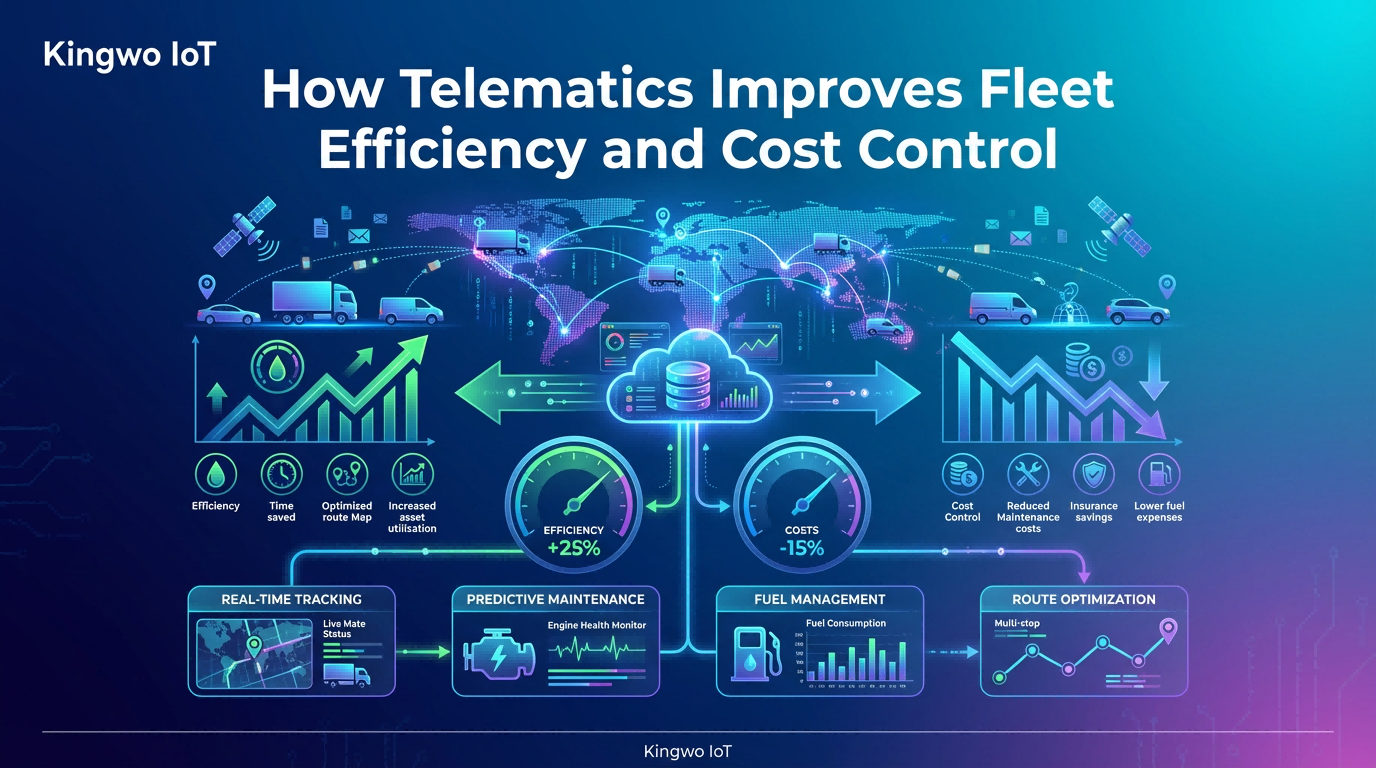

Fleet efficiency and cost control have become critical priorities for modern logistics operators. As fleets expand in scale and complexity, companies face increasing pressure to improve operational performance while keeping costs under control. Telematics adoption is no longer driven by novelty, but by necessity.
This is where telematics plays a critical role. By connecting vehicles, drivers, and backend systems, telematics enables fleets to move from reactive management to proactive, data-driven operations.
Fleet inefficiency rarely comes from a single failure. Instead, it accumulates across daily operational gaps:
Without real-time data, these inefficiencies remain invisible until costs are already incurred. Traditional manual tracking methods and periodic reporting cannot keep pace with modern fleet dynamics.
Telematics systems combine GPS positioning, vehicle diagnostics, and wireless connectivity to deliver continuous insight into fleet operations.
Key visibility capabilities include:
This continuous data flow allows fleet managers to understand not just where vehicles are, but how they are being used.
By analyzing real-time location and historical route data, telematics systems help fleets:
Even small route improvements can result in significant fuel and labor cost savings at scale.
Fuel is one of the largest operating expenses for fleet operators. Telematics enables fuel optimization by:
With this data, fleets can implement targeted interventions rather than broad cost-cutting measures.
Telematics shifts maintenance from reactive to preventive:
At the same time, utilization data helps fleets identify underused assets and rebalance capacity more efficiently.
The true value of telematics lies in its ability to connect visibility with action. When integrated with fleet management systems, telematics data supports:
Rather than relying on periodic reviews, fleets gain continuous operational intelligence.
As logistics networks become more distributed and time-sensitive, telematics is no longer viewed as an optional technology. It has become a foundational layer that supports:
Fleets that fail to adopt telematics often struggle to scale without increasing costs or operational risk.
The next stage of telematics evolution is moving beyond tracking toward intelligence. Advanced systems increasingly focus on:
This shift reflects a broader industry trend: fleets are not looking for more data, but for better decisions.
Telematics improves fleet efficiency not by adding complexity, but by reducing uncertainty. By delivering real-time visibility, actionable insights, and operational intelligence, telematics enables operators to achieve fleet efficiency and cost control while maintaining service quality.
At Kingwo, we view telematics as infrastructure rather than a standalone feature. Our solutions are designed to integrate seamlessly into fleet operations, enabling long-term efficiency, scalability, and data-driven decision-making across logistics environments.
 news
news
 news
news
 news
news
 news
news
 news
news
 news
news
 news
news
 news
news
 news
news

English

French

Portuguese

Spanish