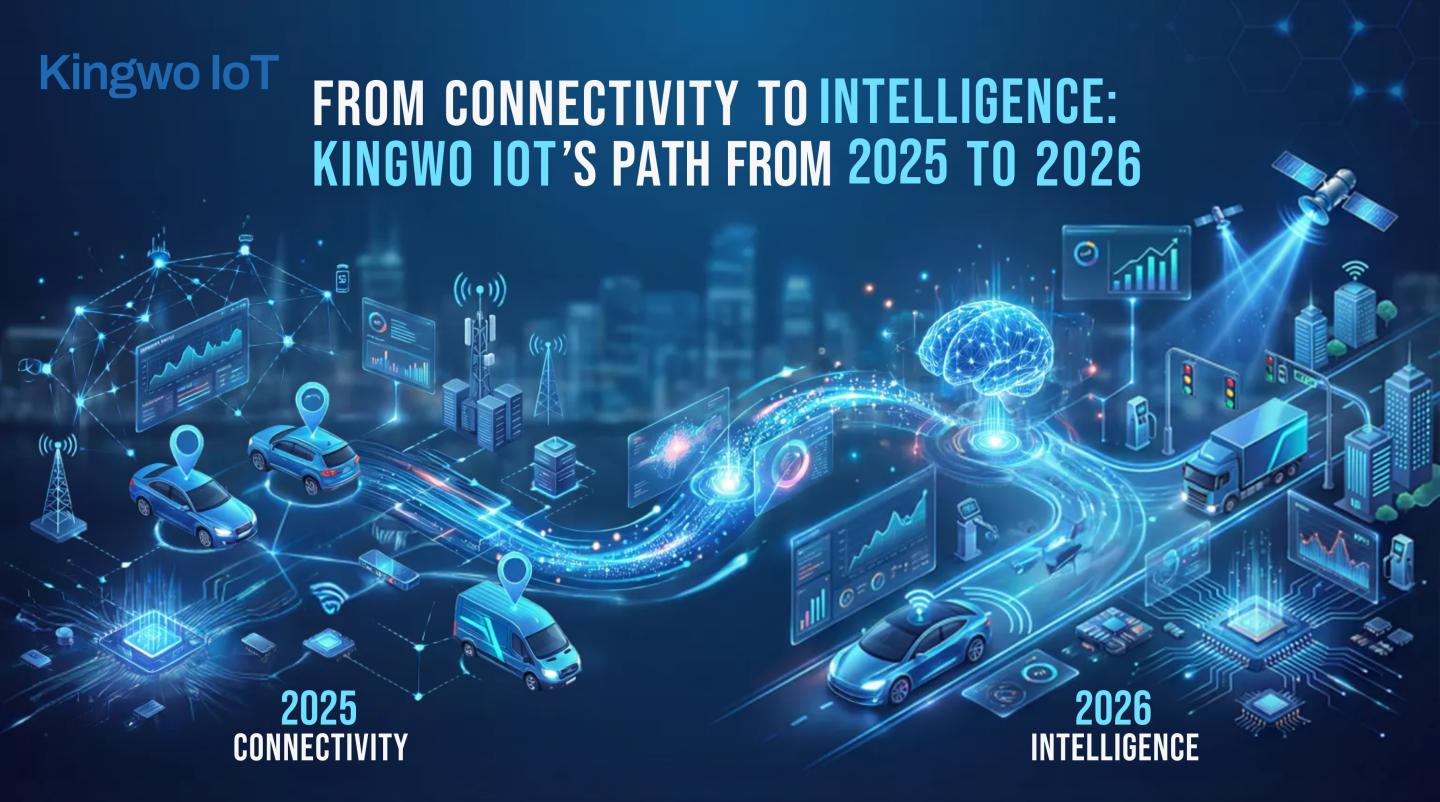

In 2025, the global IoT and telematics industry continued its shift from rapid expansion toward structural maturity. Connectivity is no longer the primary differentiator; instead, reliability, data quality, system scalability, and long-term operational value have become central to customer decision-making. Across transportation, logistics, insurance, and asset-intensive industries, expectations have moved decisively from basic visibility to actionable intelligence. Within this context, Kingwo IoT has focused on strengthening core capabilities—aligning technology development, manufacturing execution, and platform evolution with the changing demands of a more disciplined and outcome-driven market.
This year was not defined by a single breakthrough, but by steady, deliberate progress across products, platforms, manufacturing, and partnerships. As the industry moves toward 2026, Kingwo enters the next phase with increased clarity: focusing on scalable technology, dependable connectivity, and data-driven value creation.
In 2025, the IoT market matured further from rapid expansion into a phase defined by quality, reliability, and measurable outcomes. Customers increasingly demanded solutions that were not only connected, but operationally resilient, secure, and adaptable to real-world constraints. Kingwo's priorities throughout the year reflected this shift.
At the hardware level, the company continued to refine its portfolio of GPS and BeiDou-enabled tracking devices, emphasizing stability, power efficiency, and multi-network compatibility. Support for LTE Cat-1, LTE-M, NB-IoT, and legacy networks was further optimized to address diverse deployment environments, from urban fleet operations to remote industrial assets. These improvements were driven not by feature expansion alone, but by long-term lifecycle considerations such as network longevity, energy consumption, and ease of integration.
Manufacturing and quality control were also key areas of focus. Throughout 2025, Kingwo invested in process optimization across SMT assembly, device calibration, and automated testing. By strengthening in-house manufacturing capabilities, the company improved production consistency while maintaining flexibility for customized and OEM requirements. This approach enabled faster iteration cycles and tighter alignment between engineering design and production execution.
While device reliability remains foundational, 2025 underscored a broader industry transition: telematics is no longer about location visibility alone. Customers increasingly expect actionable intelligence derived from connected data.
In response, Kingwo continued to enhance its cloud-based platform, focusing on data accuracy, scalability, and interoperability. Improvements in real-time tracking, historical data analysis, and alert logic enabled customers to move from passive monitoring toward proactive decision-making. APIs and integration frameworks were refined to support compatibility with third-party systems, reflecting the growing importance of open ecosystems.
A notable trend throughout the year was the convergence of telematics with adjacent domains such as insurance analytics, predictive maintenance, and compliance management. Rather than positioning solutions around isolated use cases, Kingwo increasingly aligned its platform capabilities with broader operational workflows—supporting customers as they adapt to regulatory changes, cost pressures, and efficiency targets.
The broader market environment in 2025 reinforced several long-term trends. Usage-based insurance and data-driven risk assessment continued to gain traction, particularly in regions where insurers seek more granular behavioral insights. Asset tracking evolved toward service-based delivery models, lowering adoption barriers for small and mid-sized enterprises. Meanwhile, regulatory frameworks across transportation and logistics placed greater emphasis on traceability, safety, and emissions monitoring.
These shifts highlighted a common theme: data quality and system reliability matter more than sheer device volume. As connectivity becomes ubiquitous, differentiation increasingly depends on how effectively data is translated into operational value.
Kingwo's strategic response was measured rather than reactive. Instead of pursuing aggressive expansion into every emerging segment, the company focused on reinforcing core competencies—positioning itself as a long-term technology partner rather than a short-term solution provider.
2025 also reaffirmed the importance of global adaptability. With customers operating across Asia, Europe, the Middle East, Africa, and the Americas, Kingwo continued to refine its approach to regional requirements. Multi-constellation GNSS support, including BeiDou and GPS, ensured consistent positioning performance across geographies. Flexible connectivity options allowed deployments to adapt to local network conditions without hardware redesign.
At the same time, the company recognized that global presence does not imply uniform demand. Different markets prioritize different outcomes—cost control, compliance, operational visibility, or risk mitigation. Kingwo's solutions increasingly reflected this diversity, enabling customers to configure systems based on actual business priorities rather than fixed assumptions.
As Kingwo moves into 2026, its outlook is shaped less by short-term market fluctuations and more by structural industry evolution. Several focus areas are expected to define the coming year.
First, intelligence will take precedence over connectivity. While network coverage and device performance remain essential, value creation will increasingly depend on analytics, automation, and predictive capabilities. Kingwo plans to continue enhancing data processing frameworks, supporting customers in extracting insights that directly influence cost, safety, and efficiency.
Second, scalability and longevity will become critical decision factors. Enterprises are moving away from fragmented pilot deployments toward standardized, long-term platforms. In response, Kingwo will prioritize system robustness, long device lifecycles, and backward compatibility—ensuring solutions remain viable as networks, regulations, and operational models evolve.
Third, integration will outweigh isolation. The future of telematics lies in its ability to connect with broader digital infrastructures, from ERP systems to insurance platforms and smart city frameworks. Kingwo's commitment to open interfaces and modular design reflects this reality, enabling customers to embed telematics into their existing digital strategies.
Finally, responsible data use will continue to shape trust. As data volumes grow, so do expectations around security, privacy, and compliance. Kingwo will maintain a cautious, compliance-oriented approach to data governance, recognizing that sustainable growth depends on long-term credibility as much as technical capability.
2025 was a year of disciplined execution for Kingwo IoT—focused on strengthening foundations rather than chasing headlines. By refining hardware reliability, advancing platform intelligence, and aligning with real market needs, the company reinforced its position within a rapidly evolving industry.
Looking ahead to 2026, Kingwo remains committed to a clear principle: technology should enable better decisions, not just more data. As the IoT and telematics landscape continues to mature, this focus on practical value, operational resilience, and long-term partnership will guide the company's next chapter.
In an industry defined by constant change, steady progress remains the most sustainable strategy.
Kingwo IoT delivers intelligent IoT solutions, including GPS tracking, fleet & asset management, and smart vehicle monitoring. We combine innovative hardware with data analytics to boost efficiency, visibility, and informed decision-making—empowering businesses in a connected world.
If you would like more details, please visit Facebook, LinkedIn, INS, and Twitter pages for further information.
 news
news
 news
news
 news
news
 news
news
 news
news
 news
news
 news
news
 news
news
 news
news

English

French

Portuguese

Spanish