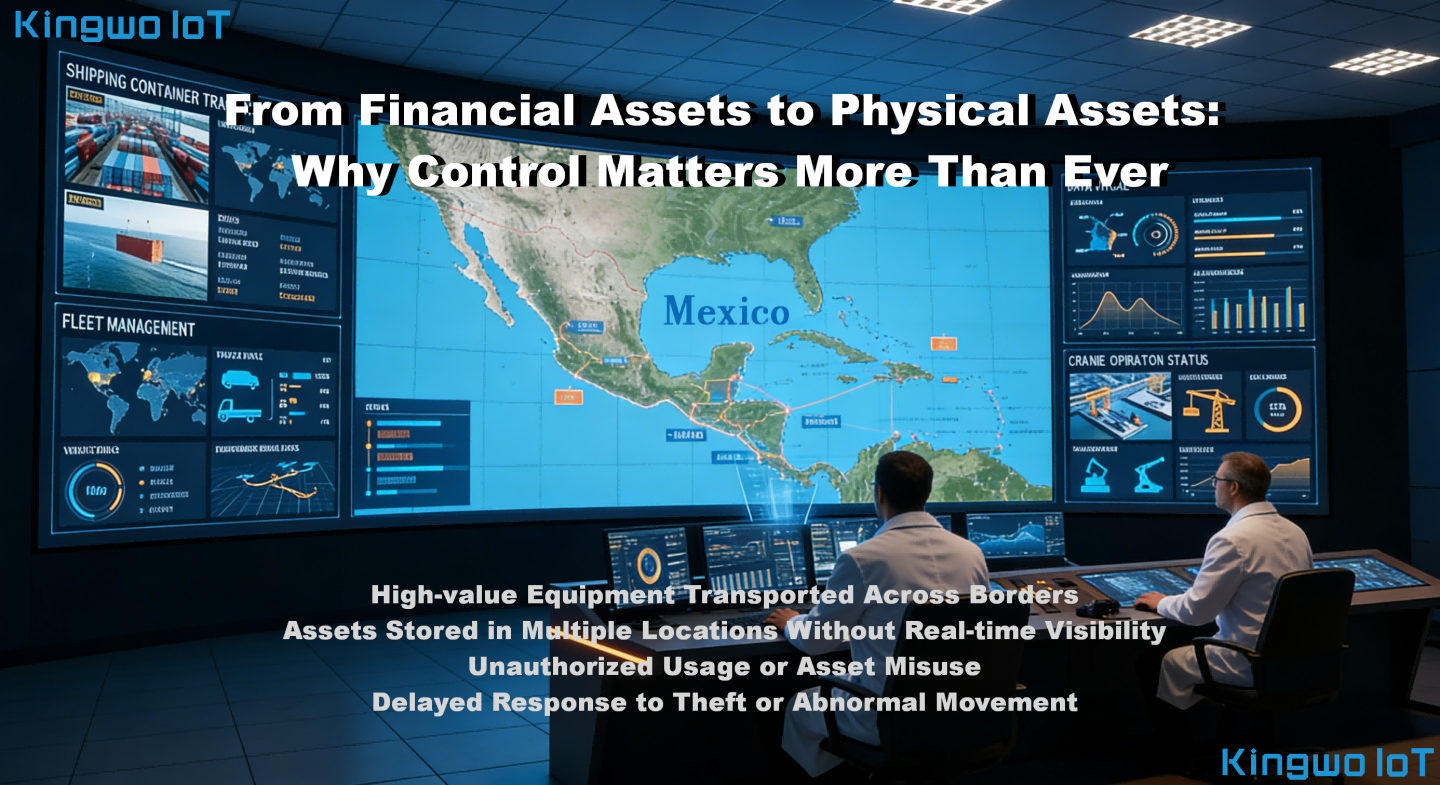

A recent development involving Victory Capital and Janus Henderson—in which Victory withdrew from a multi-billion dollar acquisition process—offers a useful lens through which to examine a broader structural shift.
While the transaction itself sits within the financial services sector, the underlying dynamics extend well beyond it. The outcome was not determined solely by valuation, capital structure, or deal engineering. Instead, it reflected a deeper constraint:
Assets that cannot be reliably controlled, aligned, or monitored introduce systemic risk—regardless of their nominal value.
This principle is increasingly relevant across industries where physical assets, mobility, and operational complexity intersect.
Traditional definitions of assets—whether financial or physical—have historically emphasized ownership and valuation. However, modern operating environments have transformed assets into dynamic, distributed systems.
In asset management:
In physical industries:
This shift introduces a fundamental challenge:
The value of an asset is now inseparable from the ability to observe, verify, and control it in real time.
Without this capability, asset value becomes theoretical rather than operational.
In sectors such as logistics, healthcare equipment, energy, and infrastructure, organizations are facing an expanding “control gap”—the growing disconnect between asset ownership and actual operational control.
While balance sheets may reflect asset ownership with precision, real-world operations present a different reality. Assets are no longer static; they move across environments, interact with multiple stakeholders, and operate within fragmented systems.
As a result:
The ability to account for assets has outpaced the ability to govern them.
This gap is not a technological anomaly—it is a structural consequence of modern operational complexity.
One of the primary drivers of the control gap is lifecycle fragmentation.
Physical assets rarely remain within a single controlled environment. Instead, they transition through multiple stages:
At each stage, control is partially transferred—or diluted—across different actors, including logistics providers, distributors, service partners, and end-users.
This creates a system where:
In such environments, ownership becomes a legal concept, while operational control becomes conditional.
Many organizations have attempted to address these challenges through tracking technologies. However, most implementations remain limited in scope.
Traditional systems are designed to answer a narrow question:
“Where is the asset?”
While necessary, this level of visibility is insufficient in complex operational environments.
Tracking often relies on periodic updates, leaving critical gaps—especially during transit or in low-connectivity conditions.
Location data alone cannot distinguish between:
Without context, visibility does not translate into actionable intelligence.
Most systems remain observational rather than intervention-oriented.
They can report anomalies, but cannot enforce corrective actions.
An asset may be visible, yet still effectively uncontrollable.
Closing the control gap requires a shift from visibility to verifiability.
Visibility answers:
Verifiability extends this to:
This represents a higher standard of operational awareness, where data is continuously validated against expected conditions.
To address these challenges, organizations are moving toward systems that integrate three foundational capabilities:
Continuous, multi-source data collection enables real-time monitoring across diverse environments.
Systems increasingly focus on detecting meaningful events, such as:
This enables earlier identification of risk.
The defining shift is the ability to act—not just observe:
At this stage, asset management evolves into a form of distributed operational governance.
The urgency of addressing the control gap is being amplified by several converging structural trends.
Across industries, assets are becoming more advanced, interconnected, and financially significant. As their value density increases, so too does the impact of loss, misuse, or operational failure. At the same time, organizations are expanding across borders, operating within increasingly decentralized environments where traditional, centralized oversight models are no longer sufficient to ensure consistent control.
This shift is further intensified by rising sensitivity to risk. Regulatory expectations are tightening, operational transparency is under greater scrutiny, and the financial and reputational consequences of asset mismanagement are becoming more pronounced. In this context, gaps in control are no longer tolerable inefficiencies—they represent material business risks.
Taken together, these trends point to a broader transformation in how assets are understood and managed.
Historically, asset management frameworks were built around relatively static concepts such as ownership, depreciation, and utilization. These models assumed a degree of stability and centralization that no longer reflects operational reality.
Today, the emphasis is shifting toward control, traceability, and real-time governance. Assets are no longer passive entities recorded on balance sheets; they are active components within distributed systems that require continuous monitoring and validation.
This transition marks a move away from static asset models toward dynamic, data-driven management approaches—where value is not only measured, but actively maintained through ongoing control.
The control gap is not simply a technological limitation—it reflects a deeper mismatch between operational complexity and legacy management frameworks.
As assets become more mobile, interconnected, and distributed, the ability to maintain continuous control will define operational resilience.
Ownership defines potential value.
Control determines realized value.
In modern asset-intensive industries, visibility alone is no longer sufficient.
Control—continuous, verifiable, and enforceable—is becoming the new standard.
This article draws on recent developments in the asset management sector, including the withdrawal of Victory Capital from its acquisition attempt of Janus Henderson.
For further details:
 news
news
 news
news
 news
news
 news
news
 news
news
 news
news
 news
news
 news
news
 news
news

English

French

Portuguese

Spanish