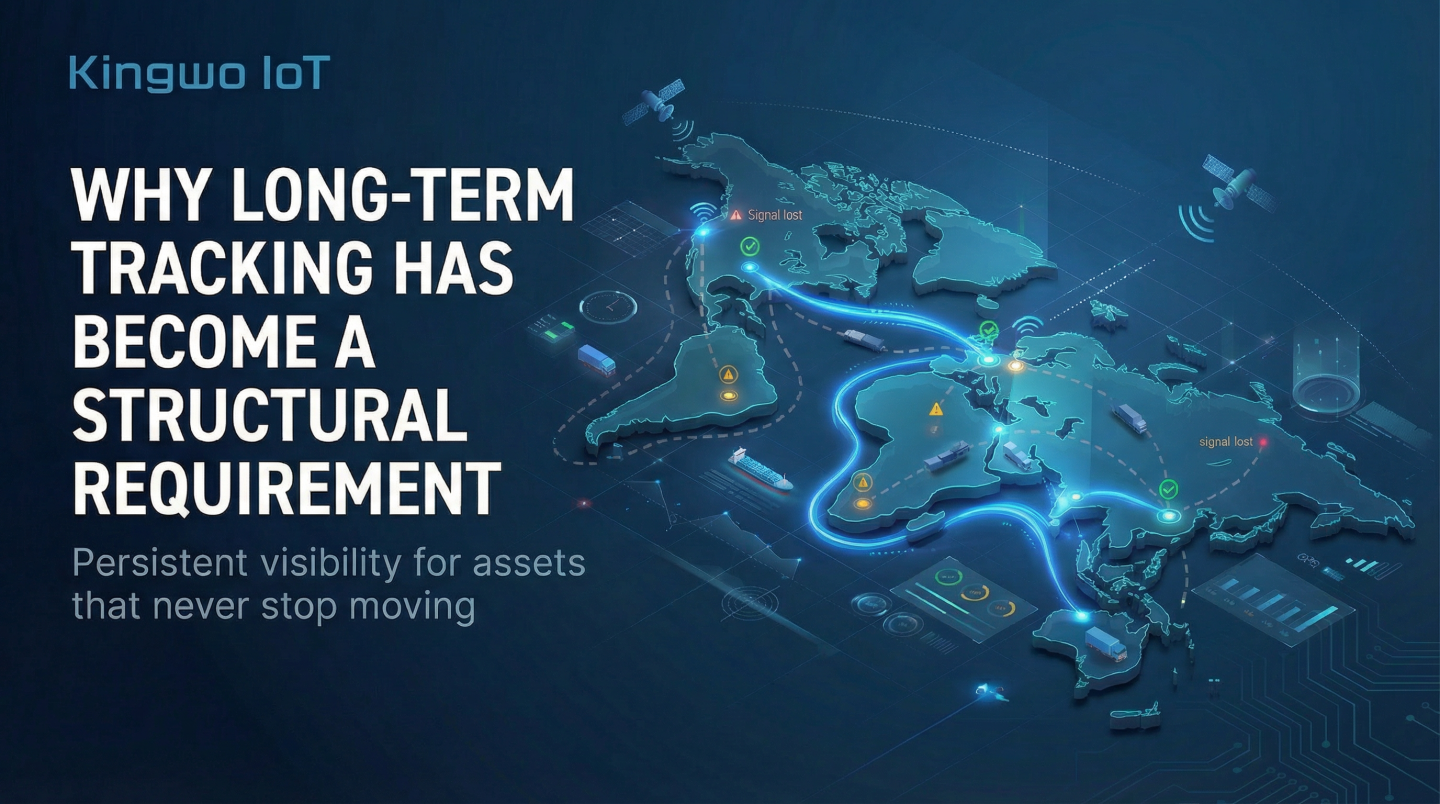

Across global supply chains, assets are moving faster, farther, and more frequently than ever before. Containers shift between ports, rail hubs, and inland depots. Mobile equipment is redeployed across projects. Temporary assets appear and disappear as demand fluctuates.
Yet while physical movement has accelerated, visibility has not always kept pace.
In recent years, logistics operators, infrastructure owners, and asset-intensive enterprises have reported a growing gap between where assets should be and where they can be confidently confirmed to be. This gap is no longer a matter of inconvenience—it has become a systemic operational risk.
The challenge is not a lack of data, but a lack of persistent, reliable, low-maintenance visibility across long asset lifecycles and complex geographies.
For decades, asset tracking relied heavily on manual reporting, periodic inspections, and fixed-location systems. These methods worked when assets were relatively static or confined to predictable routes. Today, they struggle under modern conditions.
Several structural trends are amplifying the problem:
When assets fall outside traditional monitoring coverage—even briefly—organizations experience cascading effects: delayed deliveries, idle inventory, insurance disputes, and loss of operational trust between partners.
In many cases, the absence of visibility is only discovered after a disruption has already occurred.
A common response has been to deploy tracking devices—but not all tracking models are suited to modern asset realities.
Many solutions were originally designed for vehicles, not long-life assets. As a result, they introduce new problems:
For assets such as shipping containers, construction equipment, portable infrastructure, or leased machinery, these limitations create friction rather than clarity.
What the industry increasingly requires is not real-time tracking at all costs, but long-duration, low-intervention, environment-resilient monitoring.
A shift is underway in how organizations think about asset visibility.
Instead of asking, “Can I track this asset every minute?”, the more relevant question has become: “Can I reliably know where this asset is, when it matters, without constant maintenance?”
This mindset has driven the adoption of a new class of tracking architecture characterized by:
These systems are designed to be attached once, operate quietly, and intervene only when anomalies occur.
One of the most persistent challenges in asset tracking is signal reliability.
Traditional satellite-based positioning performs well in open environments but degrades inside metal enclosures, dense urban zones, or indoor facilities. As assets increasingly move through such environments—ports, warehouses, container yards, tunnels—pure GPS solutions generate blind spots.
Hybrid positioning architectures address this by combining:
By dynamically selecting the best available signal source, these systems maintain location awareness even when one technology fails. This approach does not aim for centimeter-level precision at all times, but for continuity of awareness, which is often more operationally valuable.
Battery life has emerged as one of the most decisive factors in asset tracking ROI.
In distributed operations, the cost of replacing or recharging batteries often exceeds the cost of the device itself. Each maintenance visit introduces labor expense, scheduling friction, and operational interruption.
As a result, energy efficiency is no longer a technical preference—it is a strategic requirement.
Modern long-term trackers achieve multi-year lifespans by combining:
Rather than transmitting continuously, the device behaves more like a silent observer—reporting status periodically and escalating communication only when predefined conditions are met.
Visibility alone does not address all asset risks.
In many real-world incidents, assets are not simply lost—they are tampered with, relocated without authorization, or intentionally obscured.
This has driven the integration of environmental sensing into asset tracking devices. Features such as light exposure detection, movement alerts, and geofencing enable systems to infer intent, not just position.
For example:
These signals transform passive tracking into active risk awareness, allowing organizations to respond earlier and more precisely.
In high-volume operations, even minor installation complexity scales into significant operational cost.
Tracking solutions that require drilling, wiring, or permanent modification of assets limit flexibility. By contrast, non-invasive attachment methods—such as high-strength magnetic mounting—enable rapid deployment, redeployment, and asset reassignment.
This flexibility is particularly valuable in industries where assets are:
The ability to attach, remove, and reuse tracking hardware without specialized tools aligns with the increasingly dynamic nature of asset ownership and utilization.
The real value of modern asset tracking emerges not from maps, but from patterns.
Over time, aggregated data reveals:
These insights support better planning, utilization optimization, and risk forecasting. In this sense, long-term tracking systems serve as foundational infrastructure for broader digital transformation initiatives in logistics, construction, and asset-heavy industries.
The global asset tracking market continues to expand, driven not by novelty but by necessity. As supply chains become more complex and less tolerant of uncertainty, persistent visibility is evolving from a competitive advantage into a baseline expectation.
What distinguishes next-generation solutions is not their ability to transmit more data, but their ability to operate quietly, reliably, and autonomously over extended periods.
The industry is moving toward systems that are:
This shift reflects a deeper understanding: in a world where assets are constantly in motion, visibility must be designed to endure.
Against this backdrop, long-term asset visibility increasingly depends on purpose-built tracking hardware designed for durability, autonomy, and global deployment. One representative implementation of this approach is the LT07 4G Magnetic Asset Tracker, a device engineered specifically for containers and mobile assets that operate beyond fixed infrastructure.
The LT07 adopts a hybrid positioning framework combining GNSS, cellular-based location services, and Wi-Fi-assisted positioning to maintain location awareness across open environments, dense urban areas, and enclosed spaces. Rather than relying on a single positioning method, it dynamically selects the most reliable signal source available, reducing blind spots commonly encountered in ports, warehouses, and metal enclosures.
To address maintenance constraints, the device is powered by a high-capacity 2,700 mAh lithium battery optimized for ultra-low power consumption. Under typical reporting configurations, this architecture enables multi-year operation without battery replacement, aligning with the operational reality of assets that are difficult or costly to access. A strong integrated magnetic base allows for non-invasive installation and rapid redeployment, supporting flexible asset allocation without permanent modification.
In addition, the LT07 incorporates event-driven intelligence such as geofence monitoring and light-based tamper detection. These mechanisms extend the device’s role beyond passive tracking, enabling early awareness of unauthorized movement or physical interference. With regional variants supporting multiple 4G LTE frequency bands and 2G fallback, the LT07 is designed to operate consistently across global logistics networks, supporting long-distance and cross-border asset flows.
The value of solutions such as the LT07 is not limited to location reporting. Over time, the continuous accumulation of movement and status data forms a reliable operational record for each asset. This enables organizations to analyze utilization patterns, identify inefficiencies, and improve planning accuracy without introducing additional manual processes.
By emphasizing longevity, connectivity resilience, and minimal intervention, long-term asset trackers support a broader shift toward data-driven asset governance. They provide a stable data foundation that integrates into fleet management platforms, logistics systems, or enterprise software environments, allowing organizations to move from reactive problem-solving toward predictive oversight.
In this sense, long-life tracking devices function less as standalone tools and more as embedded infrastructure—quietly supporting decision-making across logistics, construction, transportation, and asset-intensive industries.
The future of asset management will not be defined by louder signals or denser dashboards, but by systems that fade into the background while keeping critical information within reach.
As organizations reassess how they monitor and protect mobile assets, long-term, low-maintenance tracking architectures are emerging as a practical response to real operational constraints.
In that context, the evolution of asset tracking is less about technology novelty—and more about aligning digital visibility with the physical realities of global movement.

Kingwo IoT delivers intelligent IoT solutions, including GPS tracking, fleet & asset management, and smart vehicle monitoring. We combine innovative hardware with data analytics to boost efficiency, visibility, and informed decision-making—empowering businesses in a connected world.
If you would like more details, please visit Facebook, LinkedIn, INS, and Twitter pages for further information.
 news
news
 news
news
 news
news
 news
news
 news
news
 news
news
 news
news
 news
news
 news
news

English

French

Portuguese

Spanish