

Airports and airlines are accelerating the digital transformation of baggage handling. A new service launched by easyJet and Airportr at Edinburgh Airport demonstrates how real-time luggage visibility can extend beyond the terminal—beginning at a passenger’s home, hotel, or workplace.
The service allows passengers departing from Edinburgh Airport to have their checked luggage collected before they travel. Each bag is sealed, transported to the airport, and checked in for the appropriate flight. Passengers receive a personalized tracking link and status notifications, allowing them to monitor their luggage throughout the collection and check-in process.
Traditional airport journeys require passengers to transport their own luggage, wait at bag-drop counters, and rely heavily on the airline’s internal baggage-handling system. The new model moves part of this process away from the terminal.
After their luggage has been collected and checked in, passengers can travel to the airport without carrying heavy bags, bypass conventional bag-drop queues, and proceed directly to security. This is particularly valuable for families, business travellers, elderly passengers, and people carrying oversized luggage or sports equipment.
The service also helps airports manage terminal congestion by distributing baggage collection and processing across a wider time window rather than concentrating demand around flight departure times.
For passengers, convenience is only one part of the service. The ability to check the latest status of their luggage provides greater confidence throughout the journey.
Every handover—from collection and transportation to airport check-in—creates a critical point in the baggage journey. Without sufficient visibility, passengers may not know whether their bags have been collected, delivered to the correct terminal, or successfully checked in.
Digital tracking creates a more transparent chain of custody. It can provide time-stamped status updates, collection confirmation, check-in records, and delivery information. If a delay or exception occurs, service providers can identify the affected stage more quickly and take action before the luggage misses its scheduled flight.
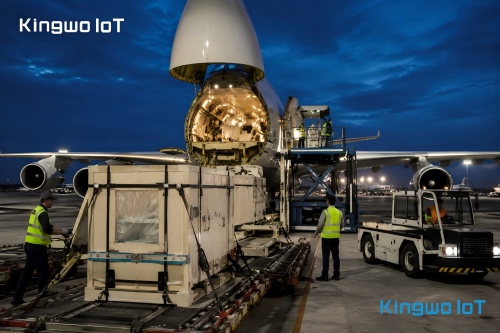
The same visibility requirements apply throughout the wider airport ecosystem. Airports manage thousands of mobile assets every day, including baggage carts, cargo containers, unit load devices, ground-support equipment, maintenance tools, service vehicles, and high-value air cargo.
Many of these assets frequently move between terminals, cargo warehouses, aircraft stands, maintenance areas, and off-airport logistics facilities. Manual records and periodic barcode scanning can confirm that an asset passed a specific checkpoint, but they may not provide continuous information about its current location.
A connected asset-tracking system can help airport and cargo operators monitor asset movements, identify unauthorized transfers, reduce search time, improve equipment utilization, and respond more quickly when an item leaves its assigned operational area.
No single positioning technology can cover every part of an airport operation. Effective airport asset visibility may require a combination of technologies.
Bluetooth and RFID can support item identification and short-range tracking inside terminals, sorting facilities, and cargo warehouses. GNSS and cellular IoT devices can provide broader location visibility for baggage vehicles, cargo containers, trailers, and mobile equipment operating outdoors or travelling between facilities.
Cloud-based platforms can consolidate this information and provide real-time locations, historical movement records, geofencing, movement alerts, device-status monitoring, and operational reports. Through API integration, tracking information can also be connected to airline, airport, cargo management, and customer service systems.
The easyJet and Airportr service reflects a wider change in aviation: passengers and operators increasingly expect assets to remain visible throughout the entire journey, rather than only at individual scanning points.
For airport and air-cargo operations, asset tracking is no longer limited to answering one question—“Where is it?” A modern system must also help determine whether an asset followed the correct route, entered or left an authorized area, remained at one location for too long, or experienced an unexpected movement.
Kingwo develops IoT tracking hardware, connectivity solutions, management platforms, mobile applications, and API services for different asset-management scenarios. Depending on operational and regulatory requirements, connected tracking solutions can support the management of airport vehicles, ground equipment, baggage carts, reusable logistics assets, air-cargo containers, and valuable shipments.
For tracking devices transported aboard aircraft, operators must also consider airline approval, radio-frequency restrictions, battery specifications, communication modes, and applicable aviation regulations. Hardware and platform solutions should therefore be selected and configured according to the specific airport, airline, and cargo-handling environment.
As baggage services move from the airport terminal to passengers’ doorsteps, the tracking boundary is expanding as well. The future of airport operations will depend on continuous, secure, and actionable visibility—from the first collection point to the aircraft and the final destination.
Kingwo is not affiliated with easyJet, Edinburgh Airport, or Airportr. This article discusses the development from the perspectives of industry and IoT asset tracking.
References: easyJet luggage-service report
By Kailiang Tang
Acting Marketing Director, Kingwo IoT
 news
news
 news
news
 news
news
 news
news
 news
news
 news
news
 news
news
 news
news
 news
news

English

French

Portuguese

Spanish