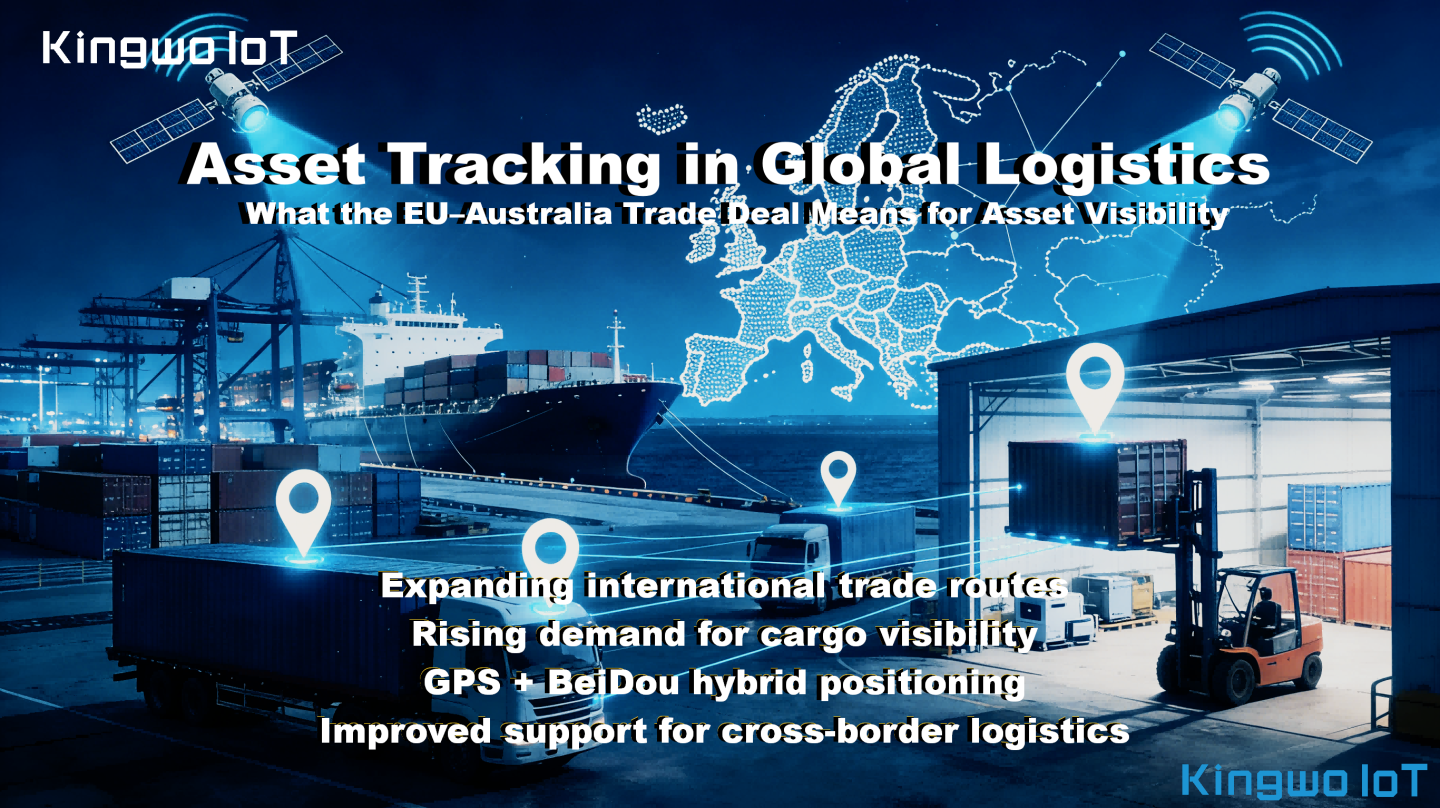

Asset tracking in global logistics is becoming increasingly critical as international trade continues to expand.
The conclusion of the EU–Australia free trade agreement is more than a trade policy headline. It is also a clear sign that global supply chains are entering a new phase—one defined by diversification, longer trade corridors, and higher operational complexity. The agreement was announced on March 24, 2026, after eight years of negotiations, and both sides framed it as part of a broader effort to strengthen resilience, diversify trade relationships, and deepen strategic cooperation.
For global logistics companies, freight operators, and asset-intensive businesses, that shift matters immediately. More trade activity between Europe and Australia means more cargo in motion, more cross-border transfers, and more pressure on logistics networks to maintain visibility at every stage of the journey.
In practical terms, this raises a simple but increasingly important question:
How well can businesses see, monitor, and manage their assets once those assets begin moving across longer and more complex international routes?
The logic is straightforward. As trade routes expand, the number of moving assets increases. Goods do not simply travel from one point to another. They pass through ports, warehouses, inland transport networks, customs checkpoints, and regional delivery nodes. Every additional handoff introduces new operational risk.
For B2B logistics businesses, asset visibility now supports far more than location reporting. It affects:
That is why the discussion around asset tracking is changing. Businesses are no longer satisfied with knowing where a shipment was a few hours ago. They increasingly expect continuous, reliable, and usable tracking data across the full transport cycle.
Many tracking devices on the market still rely too heavily on conventional GPS-only logic. In simple scenarios, that may be enough. In real international logistics environments, it often is not.
Common limitations include:
Containers, underground loading areas, warehouses, urban corridors, and metal-heavy transport environments can reduce signal quality or interrupt positioning.
A tracking device may stop reporting accurately if it loses network coverage or lacks backup positioning methods.
Basic devices may show a point on the map. Still, they often do not provide enough context for fleet operators or asset managers who need to understand status, movement quality, or equipment usage.
As a result, many logistics operators are moving away from the idea that asset tracking should be “just GPS.”
The industry is gradually moving toward hybrid positioning and connectivity, where multiple technologies work together rather than relying on a single source.
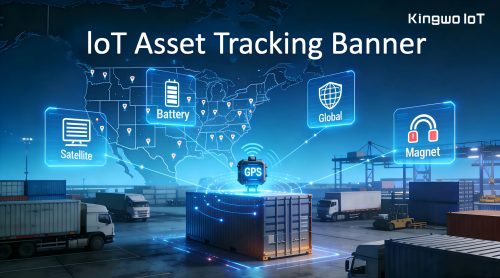
A more modern asset tracking architecture may combine:
This matters because real logistics conditions are rarely ideal. Devices need to continue working when satellite conditions are weak, when transport routes cross network environments, or when operators need more than a map coordinate.
In other words, the value of a tracking system increasingly depends on continuity, not just nominal positioning accuracy.
One of the more important developments in this space is the growing relevance of multi-constellation positioning, especially the use of the Beidou Navigation Satellite System.
For years, many international asset tracking solutions were built primarily around GPS. That model is changing. As global logistics networks become more diverse, businesses are seeking stronger signal resilience, broader compatibility, and more stable positioning performance across varying operating conditions.
In this context, BeiDou is no longer viewed only as a domestic Chinese navigation system. It has become part of the broader global positioning ecosystem and is increasingly relevant in commercial applications that require dependable tracking performance across regions.
For logistics and warehousing scenarios, the practical advantage is not about replacing one system with another. It is about improving reliability through multi-source positioning.
Europe already has one of the world’s most mature cross-border logistics environments. The deeper integration of trade with Australia adds another layer of long-distance movement and supply chain coordination.
In warehouse and transport operations, asset tracking can support several clear use cases:
For operators managing trucks, trailers, containers, industrial equipment, or mobile business assets, the benefit is not only visibility. It has also improved decision-making.
That is especially true when a tracking solution supports newer capabilities such as low-power communication, stronger fallback positioning, and vehicle-side data integration.
The EU–Australia trade agreement does not directly change how a tracking device works. But it does reinforce a larger market trend:
The more global trade expands, the more valuable asset visibility becomes.
As supply chains stretch across longer distances and more operating environments, the standard for asset tracking rises as well. Businesses increasingly need systems that are not only connected but also stable, scalable, and suited to real B2B logistics use cases.
That is where newer-generation solutions are becoming more relevant.
At Kingwo IoT, we are seeing rising interest in asset tracking technologies built for global logistics environments—especially solutions that combine satellite positioning, cellular fallback, low-power communication, and practical fleet integration. For businesses managing cargo, vehicles, and mobile assets across borders, the goal is no longer just to “see” an asset. It is to maintain dependable visibility throughout the entire operational journey.
The EU–Australia trade deal is ultimately a trade story, but it is also a logistics story.
It points to a future in which more goods move across more routes, through more nodes, under greater pressure for speed, security, and transparency. In that environment, asset visibility becomes a competitive necessity.
For logistics businesses, warehouse operators, and global B2B supply chain teams, modern asset tracking is no longer just a technical tool. It is part of the infrastructure required to operate with confidence in a more connected and more demanding global market.
This article is based on public information released by the European Commission, the Australian Government, and international media reporting on the EU–Australia free trade agreement announced on March 24, 2026.
 news
news
 news
news
 news
news
 news
news
 news
news
 news
news
 news
news
 news
news
 news
news

English

French

Portuguese

Spanish