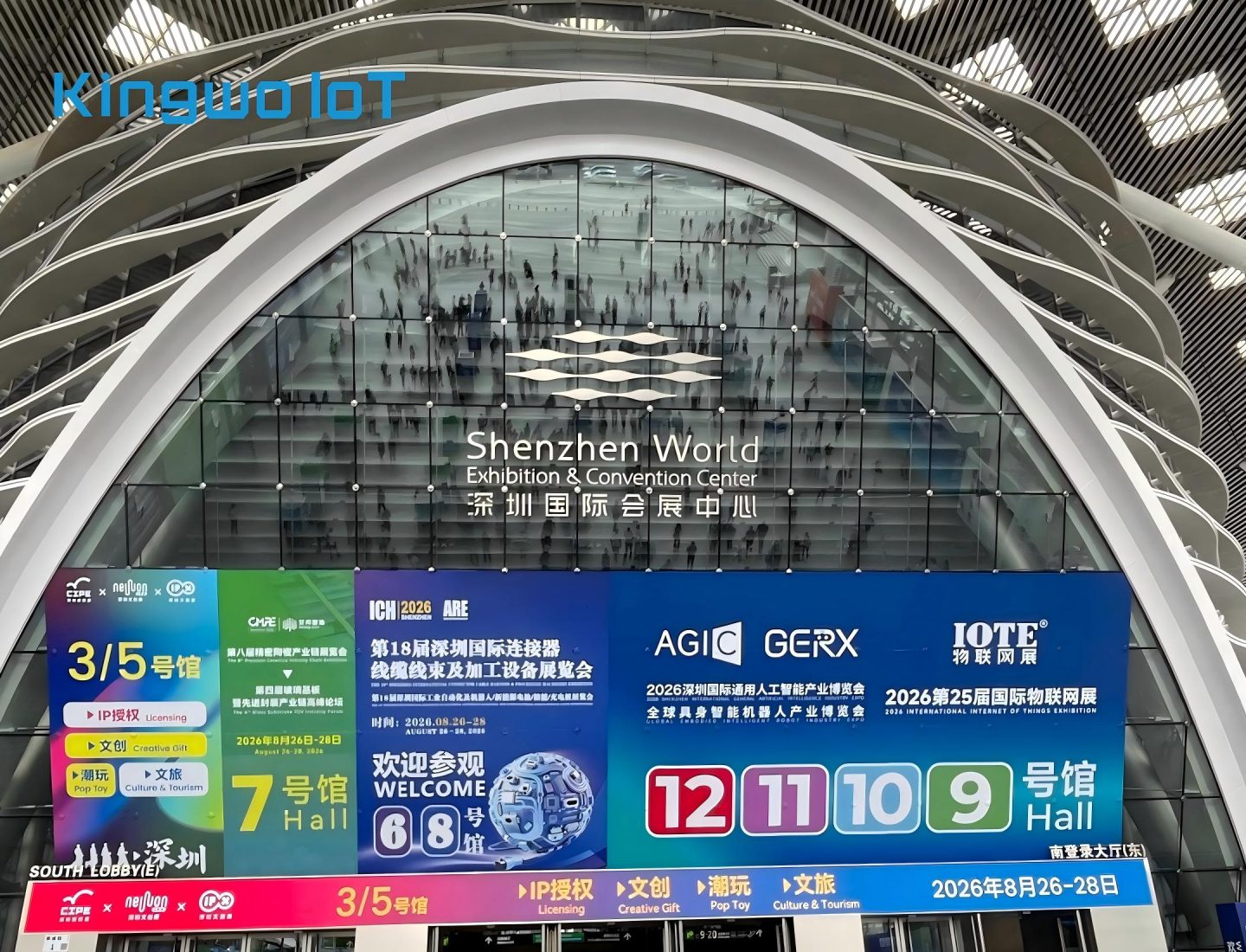

From August 26 to 28, IOTE 2026 Shenzhen brought the global AIoT ecosystem together at the Shenzhen World Exhibition & Convention Center.
The event gathered more than 1,000 exhibitors across 80,000 square metres. According to the organizer, the opening day welcomed 48,109 industry professionals, including more than 3,000 overseas visitors. Technologies ranging from RFID and passive IoT to precise positioning, low-power connectivity, edge computing, intelligent terminals and AI models were presented across more than twenty application sectors. IOTE 2026 official opening report
Yet the most important message from the exhibition was not one individual product. It was the growing convergence between artificial intelligence and the physical world.
For several years, much of the AI conversation focused on models, computing power and software. At IOTE 2026 Shenzhen, the emphasis was increasingly placed on what happens after AI leaves the cloud and enters factories, vehicles, warehouses, retail environments and mobile assets.
An AI system can only understand the physical world through reliable data. For fleet operators, logistics providers, rental businesses and asset owners, that data begins with connected hardware: a sensor, a communication module, a positioning device or another compact endpoint attached to the physical asset. Without this layer, an AI platform may be powerful, but it remains disconnected from what is actually happening on the road, inside a warehouse or across a distributed asset network.
This is why IoT hardware is not becoming less important in the AI era. It is becoming the foundation on which practical AI applications are built.
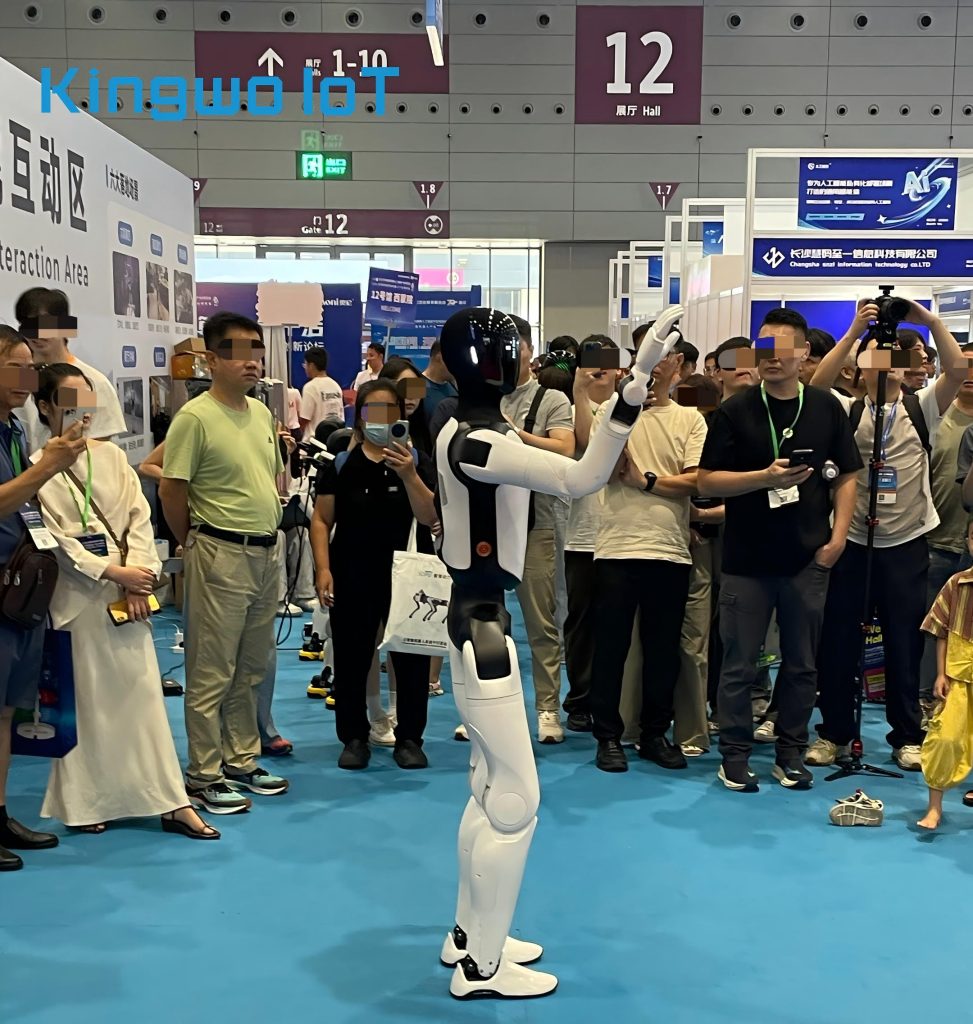
The exhibition layout itself reflected this transition.
Hall 9 focused on passive IoT, RFID and intelligent data-acquisition terminals. Hall 10 brought together industrial connectivity, sensing and high-precision positioning. Hall 11 featured intelligent hardware, smart labels and traceability solutions, while Hall 12 showcased edge AI, AI chips and industry-specific intelligent systems.
More than 1,200 technology products were reportedly displayed during the event. Among the highlighted developments were battery-free sensing, ultra-low-power wireless chips, smart labels, edge AI hardware and new connectivity solutions for screenless IoT devices.
Taken together, these developments point toward an important industry shift: the next connected endpoint may not look like a conventional tracker.
As IoT moves deeper into real operational environments, size, power consumption, installation method and physical form are becoming just as important as communication technology.
The future will require devices that can become part of the asset itself—discreetly integrated into a vehicle component, battery enclosure, piece of equipment, reusable container or logistics package.
Traditional tracking systems were designed primarily to answer one question:
“Where is the asset?”
AIoT systems are gradually moving toward more valuable questions:
Location remains essential, but its value increases when it is combined with time, motion, sensor events, device status and operational context.
AI does not replace the IoT endpoint. It helps transform the data collected by that endpoint into decisions, alerts and business intelligence.
For logistics operators, this could mean identifying abnormal cargo movement earlier. For e-bike and rental fleets, it could mean recognizing unauthorized use or unusual parking behaviour. For equipment owners, it could mean understanding utilization rather than simply knowing the last reported position.
The evolution is therefore not only from offline assets to connected assets. It is from connected assets to understandable assets.
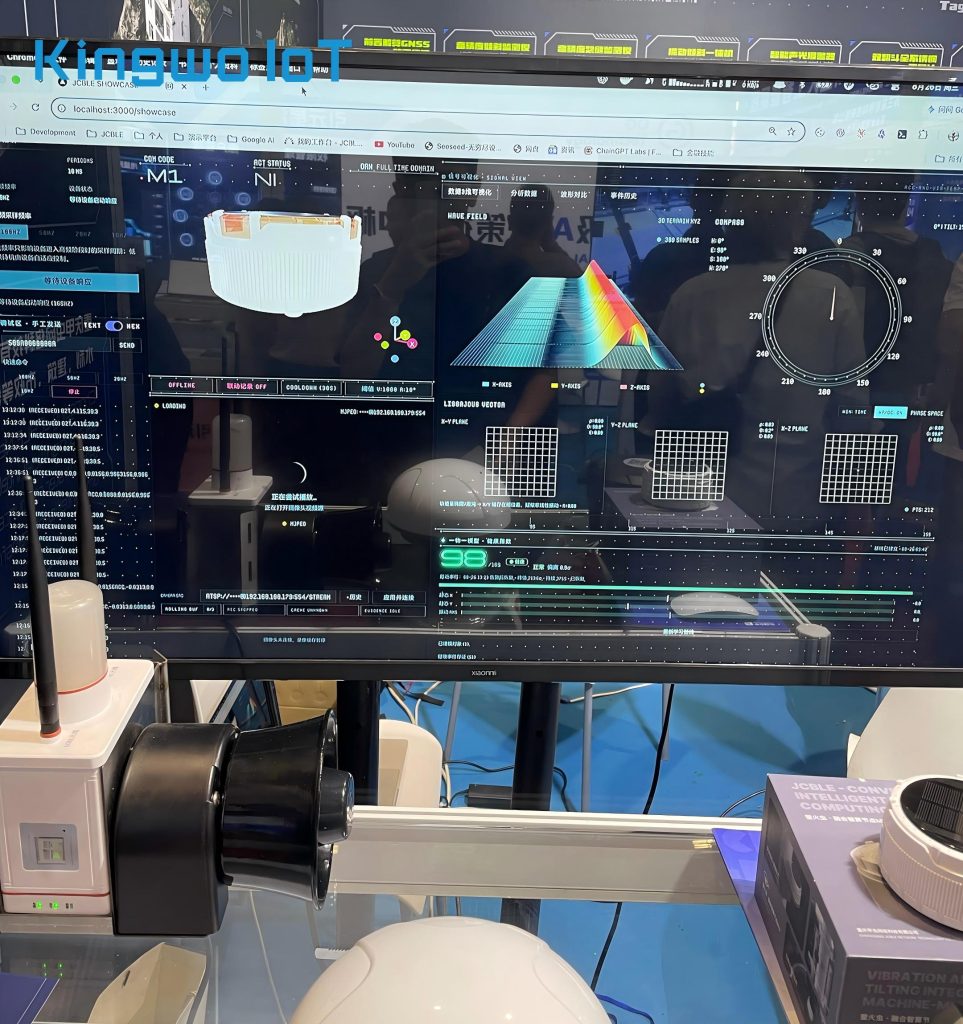
Another lesson from IOTE 2026 Shenzhen is that AIoT hardware is becoming increasingly application-specific.
An e-bike may require concealed installation, weather resistance and protection against vibration. A non-powered trailer may prioritize long standby time and wide-area communication. A returnable logistics container may need a low-maintenance device that can remain with the asset for years. A high-value shipment may require a temporary and highly discreet form of protection.
These scenarios may use similar positioning or communication technologies, but they do not require the same physical product.
This is where industrial design, power management and customization become critical. Instead of asking customers to adapt their operations to an existing device, manufacturers will increasingly need to design the endpoint around the asset, its environment and its commercial model.
In some cases, the most effective IoT hardware may be the device that operators and unauthorized users hardly notice.
The exhibition also highlighted the growing importance of connectivity lifecycle management.
Solutions based on the GSMA SGP.32 eSIM architecture for screenless IoT devices were displayed alongside regional multi-network, global single-SIM and cellular-plus-satellite connectivity models. This reflects the growing demand for devices that can be deployed across different markets without rebuilding the entire connectivity architecture for every country.
For international AIoT projects, hardware is only one part of the equation. Device identity, network coverage, data security, communication protocols, platform integration and remote configuration must be considered together.
A truly scalable solution must work not only during a laboratory demonstration, but throughout years of real deployment across different operators, platforms and regulatory environments.
At Kingwo IoT, our view is straightforward: the next generation of connected hardware should adapt to the asset, rather than forcing the asset to adapt to the hardware.
Our experience across vehicle telematics, e-bike connectivity, fleet management and non-powered asset tracking has shown that customers increasingly need more than a standard device selected from a catalogue.
They need the right combination of positioning, low-power operation, communication flexibility, configurable data protocols, private-server integration and application-specific industrial design.
As AIoT continues to move into mobility, logistics, rental operations and asset protection, Kingwo IoT is exploring how connected endpoints can become more compact, discreet and closely integrated with their real-world environments.
We are particularly interested in hearing from platform companies, fleet operators, logistics providers, mobility businesses and solution integrators managing assets that remain difficult to connect.
If existing trackers are too visible, too large, too power-hungry or simply not designed for your application, there may be another way to approach the problem.
Sometimes the most valuable new IoT product begins not with an existing catalogue, but with an overlooked asset and the right question.
The future of AIoT may be increasingly intelligent — and increasingly invisible.
By Kailiang Tang
Acting Marketing Director, Kingwo IoT
 news
news
 news
news
 news
news
 news
news
 news
news
 news
news
 news
news
 news
news

English

French

Portuguese

Spanish