Electric motorcycles are moving rapidly from personal transportation into commercial operations. Across Vietnam, Southeast Asia and Latin America, they are being deployed by delivery platforms, rental businesses, ride-hailing fleets, vehicle-financing companies and battery-swapping operators.
This transition is creating a market that extends far beyond the sale of the motorcycle itself. Once hundreds or thousands of electric motorcycles enter daily operation, operators need to know whether each vehicle is active, where it is being used, whether it has left its assigned area and whether there are signs of unauthorized movement or abnormal operation.
For these businesses, every electric motorcycle is a mobile, revenue-generating asset. Losing visibility over that asset can quickly become a financial and operational problem.
Vietnam has become one of the clearest examples of how quickly an established motorcycle market can begin shifting toward electric mobility.
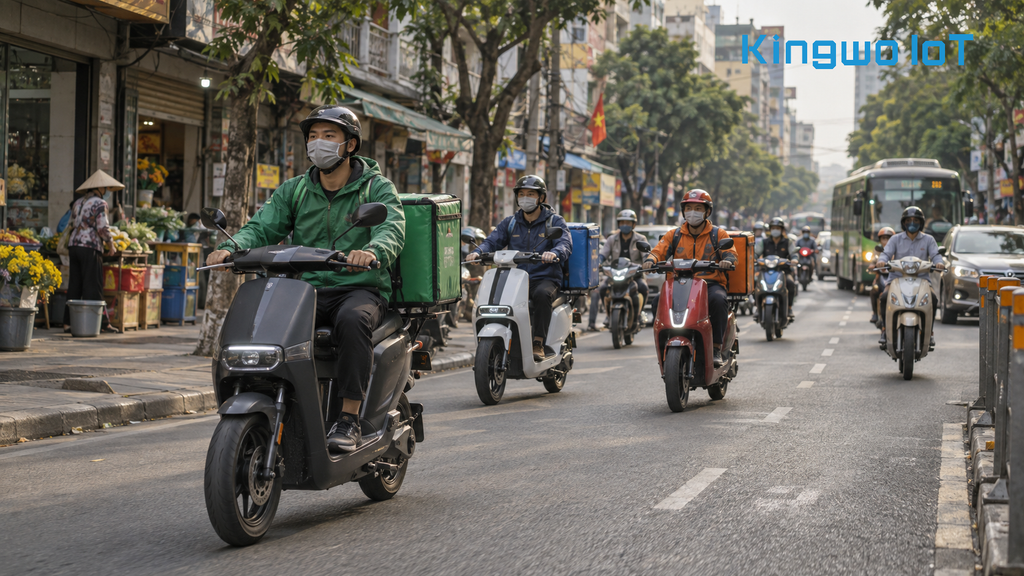
According to the International Energy Agency, electric two-wheeler sales across Southeast Asia increased from approximately 235,000 units in 2020 to almost 900,000 units in 2025. Vietnam was the region’s largest market, with sales more than doubling to approximately 735,000 electric two-wheelers in 2025. Electric models accounted for more than 20% of the country’s two-wheeler sales that year. IEA Global EV Outlook 2026
The size of this change matters. Vietnam is not simply replacing one type of personal motorcycle with another. Electric two-wheelers are also becoming part of delivery networks, urban mobility services, rental businesses and new battery-leasing models.
As more manufacturers introduce affordable electric motorcycles and more operators adopt battery swapping or subscription-based services, the commercial relationship with the vehicle becomes longer and more complicated. A motorcycle may be sold through an installment plan, leased to a delivery rider, transferred between different operating zones or managed by a local distributor on behalf of a fleet owner.
In each of these cases, the company carrying the financial risk needs continuous visibility over the vehicle.
The traditional motorcycle business largely ends when a vehicle leaves the dealership. Commercial electric mobility works differently.
A fleet operator may retain ownership of the vehicle. A financing company may still be waiting for monthly payments. A battery operator may need to coordinate motorcycles with charging or swapping infrastructure. A rental company may need to identify vehicles that have remained idle, crossed a geofence or been used outside approved hours.
This is why electric motorcycle connectivity cannot be reduced to a single location point on a map. Positioning is important, but the greater value comes from connecting location with vehicle status and operational behaviour.
If a motorcycle stops reporting, the operator needs to know. If it moves unexpectedly during the night, that movement may require attention. If it repeatedly leaves its operating zone, the fleet manager may need to investigate. If a vehicle remains unused for several days, the problem could involve maintenance, battery availability, driver performance or customer payment.
These are operational questions, not simply tracking questions.
Vietnam is currently attracting the most attention, but the same commercial logic applies across other parts of Southeast Asia. Indonesia, Thailand, the Philippines and several neighbouring markets all have strong motorcycle cultures, dense urban delivery networks and growing interest in two-wheeler electrification.
The IEA reported that Indonesia recorded approximately 105,000 electric two-wheeler sales in 2024, while the Philippines exceeded 25,000. The region is also attracting new manufacturing investment as established Asian vehicle brands expand local production and distribution. IEA Global EV Outlook 2025
However, electric motorcycles operating in these markets face conditions that differ significantly from those found in many European mobility projects. Vehicles may operate for long hours in high temperatures, heavy rain and dense traffic. They may pass between riders or dealerships, travel through areas with inconsistent network coverage and remain in service far longer each day than an ordinary privately owned vehicle.
This makes hardware reliability, installation stability and communication recovery particularly important. A system designed for these markets must do more than perform well during a short demonstration. It must continue reporting under real commercial conditions.
Latin America represents another important opportunity. The region already has an enormous motorcycle population, driven by affordability, urban congestion and the rapid growth of app-based delivery work.
The United Nations Environment Programme estimates that Latin America and the Caribbean are home to approximately 60 million motorized two- and three-wheelers. Around 5.6 million new units were registered in 2024, demonstrating the scale of the regional market even before electric motorcycles achieve mainstream adoption. UNEP Global Electric Two- and Three-Wheeler Conference
Electric delivery projects are also beginning to produce practical results. In Quito, Ecuador, an electric cargo-bike initiative covered approximately 25,000 kilometres and transported 300 tonnes of goods. According to data reported by UNEP, the project also avoided approximately six tonnes of carbon dioxide emissions while demonstrating that electric two- and three-wheelers can operate successfully in demanding urban delivery environments. United Nations Environment Programme
For markets such as Brazil, Colombia, Ecuador and Peru, electric motorcycles may become particularly attractive to delivery companies, independent riders and rental operators seeking to reduce fuel and maintenance costs. However, these vehicles may also be distributed across large urban areas, assigned to different riders and financed through long-term payment plans.
Under those conditions, asset visibility becomes part of risk management. A vehicle that cannot be monitored is more difficult to finance, recover, maintain and redeploy.
For an electric motorcycle operator, a location record becomes far more useful when it is connected to the daily operation of the vehicle.
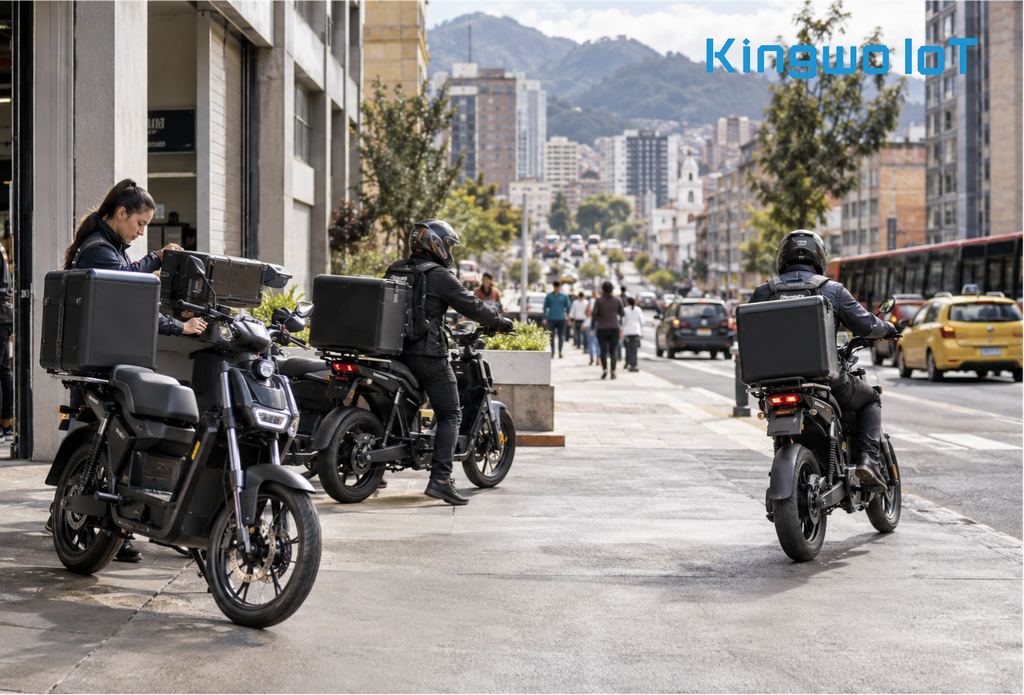
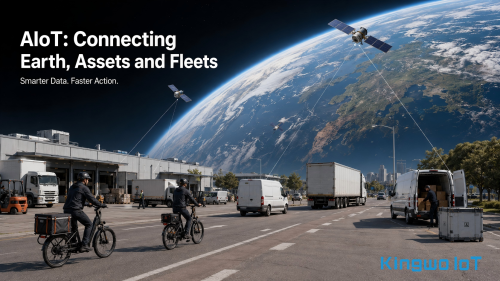
Real-time positioning and route history can help identify how motorcycles are being used. Geofences can define authorized operating areas. Movement and tamper-related alerts can provide an early warning when a vehicle behaves unexpectedly. Remote management functions can support rental, financing and fleet-control processes. Vehicle data can also be transmitted to a central platform, allowing operators to evaluate utilization across an entire fleet rather than inspecting one motorcycle at a time.
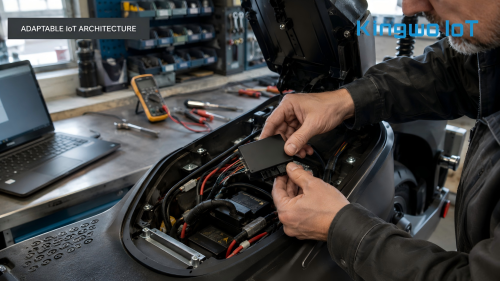
Depending on the vehicle architecture, an IoT terminal can also communicate with components such as the controller, instrument cluster or other onboard equipment. This creates an opportunity to combine positioning with vehicle-status information and turn a standalone tracker into part of the motorcycle’s digital operating system.
The purpose is not to generate the largest possible volume of data. It is to provide the right information at the moment an operator needs to make a decision.
There is no single deployment model that fits every electric motorcycle business.
A manufacturer in Vietnam may want connectivity integrated during vehicle production. A delivery company may need a fleet-management platform that can be deployed quickly. A battery-swapping operator may require vehicle and battery information to work together. A Latin American financing company may focus more heavily on geofencing, unauthorized movement and remote asset control.
Some companies require a complete device-and-platform solution. Others already operate their own software and need the hardware to communicate directly with a private server. Local distributors may also require customized reporting logic, communication protocols or firmware configurations before introducing the solution to their market.
This flexibility is particularly important in emerging markets, where business models are still developing, and local operating requirements can change quickly.
Kingwo IoT develops connected hardware and fleet-management solutions for electric motorcycles, E-bikes, delivery fleets, rental operators and vehicle manufacturers.
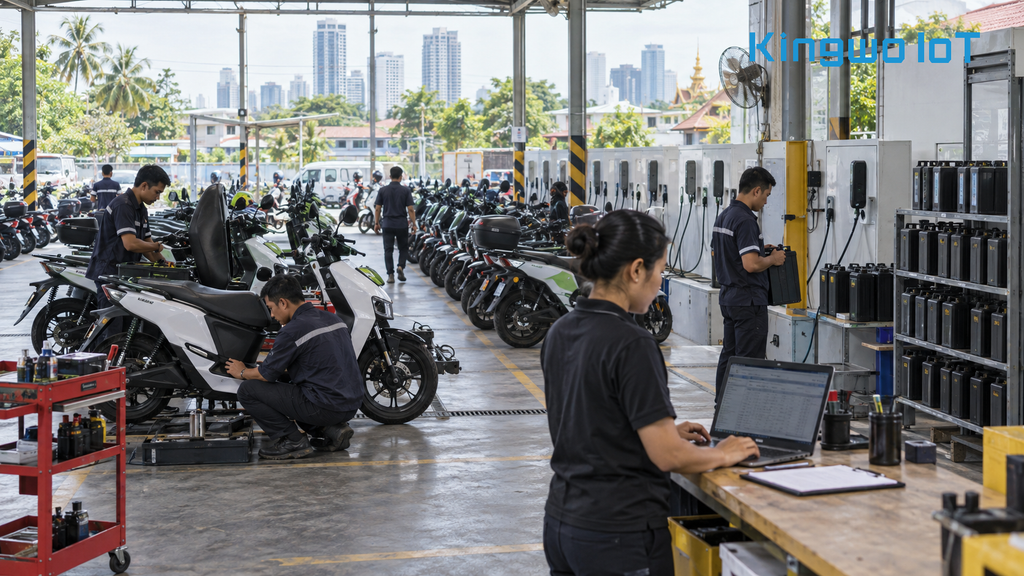
Solutions such as the LT420 are designed for electric bike and motorcycle integration and can provide a data connection between the vehicle and the operator’s management system. Depending on project requirements, Kingwo IoT can support vehicle positioning, route records, geofence management, operational alerts, remote-control functions and vehicle-data communication.
For customers with their own platform, Kingwo devices can also be evaluated for connection to a private server; for manufacturers and distributors, hardware, firmware, communication protocols and reporting logic can be adapted according to the vehicle and commercial model.
This allows connectivity to be treated as part of the electric motorcycle itself—not simply as an accessory installed after the vehicle has entered the market.
The next stage of electric motorcycle development will not be decided only by battery capacity, motor power or retail price.
As commercial fleets expand, operators will increasingly compete on vehicle utilization, asset security, maintenance efficiency and the ability to manage distributed motorcycles from a central system. Manufacturers will also need to offer more than the physical vehicle if they want to work with delivery platforms, rental companies, financial providers and large fleet customers.
Vietnam and the wider Southeast Asian market are already demonstrating how quickly electric two-wheelers can scale. Latin America has the motorcycle population, delivery demand and urban operating conditions to create another important growth market.
In both regions, the same principle applies: once an electric motorcycle becomes a commercial asset, it must remain visible, connected and manageable throughout its operating life.
Kingwo IoT is ready to work with electric motorcycle manufacturers, fleet operators, platform companies and regional distributors to build practical connected-vehicle solutions for these emerging markets.
By Kailiang Tang
Acting Marketing Director, Kingwo IoT
 news
news
 news
news
 news
news
 news
news
 news
news
 news
news
 news
news
 news
news
 news
news

English

French

Portuguese

Spanish