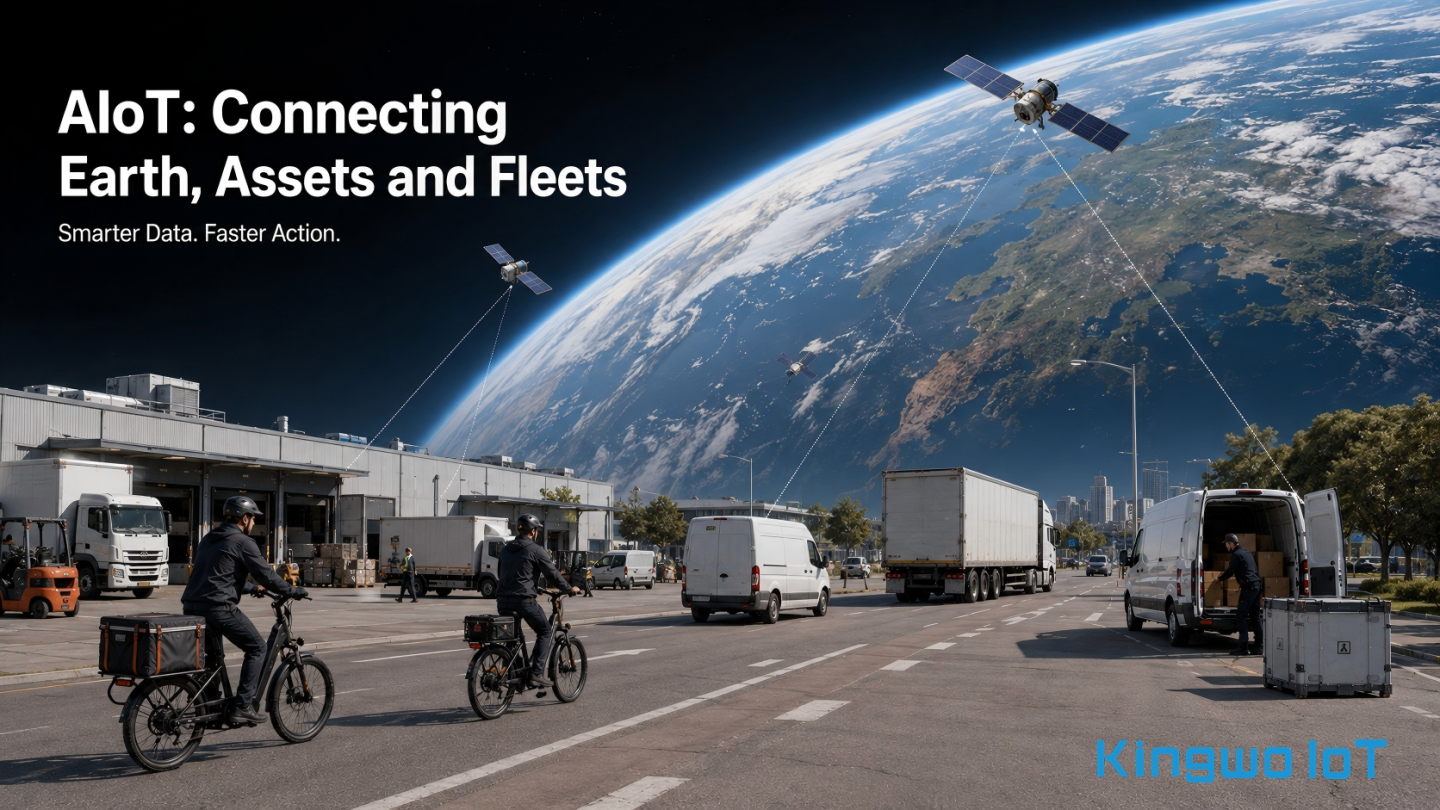

For years, the Internet of Things was largely defined by connectivity.
Devices collected information, sent it to a cloud platform, and waited for people or software systems to interpret it. A GPS tracker reported a location. A sensor reported a temperature. A vehicle terminal reported ignition status or mileage.
That model is now changing.
The convergence of Artificial Intelligence and the Internet of Things—commonly known as AIoT—is transforming connected devices from passive data transmitters into intelligent operational tools. According to recent industry discussions from the GSMA, AI, edge computing, energy-efficient connectivity and IoT are increasingly converging to create more autonomous connected systems. GSMA’s 2026 IoT Summit highlighted this transition as a defining direction for the next generation of IoT.
Traditional IoT systems generate large quantities of raw data. However, data alone does not necessarily create business value.
A fleet operator may receive thousands of location points every day, but the real value comes from identifying unusual routes, unauthorized use, excessive idling, unsafe driving or potential theft.
An E-bike operator does not simply need to know where every bicycle is located. The operator needs to understand which vehicles may have been moved illegally, which batteries may require attention, which parking areas are becoming overloaded and which units are likely to require maintenance.
AIoT helps transform individual data points into operational context.
By combining location, motion, ignition, vibration, battery, temperature and other sensor data, intelligent systems can identify patterns and prioritize events that require human attention. This can reduce unnecessary alerts while enabling companies to respond more quickly to genuine risks.
One of the most important developments behind AIoT is the growth of edge intelligence.
Instead of sending every piece of raw information to the cloud, some analysis can be performed closer to the device or at the network edge. This can reduce latency, lower data consumption, and improve system resilience when network connectivity is unstable.
GSMA describes device-edge AI as a way to enable real-time decisions directly through smartphones, IoT sensors and autonomous systems with minimal delay. Qualcomm’s expanding industrial IoT portfolio also reflects this direction, with growing emphasis on low-power computing, on-device intelligence and secure edge processing.
For compact, battery-powered tracking equipment, this does not mean placing a large AI model inside every device. Intelligence can be distributed across three layers:
This distributed approach is particularly relevant to mobile assets, logistics equipment, rental fleets and battery-powered IoT devices, where energy consumption, communication costs and response speed must be carefully balanced.
The commercial impact of AIoT can already be seen across several application areas.
In fleet management, connected terminals can support driver-behaviour analysis, route optimization, maintenance planning and vehicle-risk detection.
In E-bike and shared-mobility operations, AIoT can help identify abnormal movement, unauthorized parking, battery risks and changes in vehicle utilization.
In logistics and asset management, tracking devices can support route-deviation detection, unauthorized opening alerts, dwell-time analysis and more effective asset recovery.
For construction equipment, rental assets and other high-value machinery, intelligent monitoring can help businesses distinguish between normal operation, unexpected movement and potential theft.
The same principle applies across these scenarios: the device must provide reliable real-world data before any AI system can make a useful decision.
AI does not replace IoT hardware. It increases the importance of accurate sensing, dependable connectivity and correctly designed devices.
As more companies discuss AI-powered platforms, it is easy to overlook the physical layer of an AIoT solution.
Every intelligent conclusion ultimately depends on the quality of the information collected in the field. Poor positioning, unstable connectivity, excessive power consumption or incorrectly configured sensors will produce unreliable results, regardless of how advanced the AI model may be.
Successful AIoT deployment therefore requires more than an algorithm. It requires coordination between:
This is especially important for global projects, where products must also meet different frequency-band, carrier, certification and deployment requirements.
At Kingwo IoT, we see AIoT as a complete chain connecting physical assets, reliable data and intelligent decisions.
Our role begins at the point where the physical world becomes digital.
Through vehicle GPS terminals, portable asset trackers, E-bike IoT devices, embedded tracking solutions and customized OEM/ODM hardware, we help customers collect the location, status and event data required by their own platforms and AI systems.
Depending on the project, our devices can support features such as:
We believe the future of AIoT will not be built around one universal device or one closed platform. It will be built through flexible hardware, open integration and solutions designed around specific operational environments.
Connectivity made assets visible, and AIoT is making them understandable.
As edge computing, low-power cellular technologies, intelligent platforms and AI models continue to develop, the competitive advantage will no longer come from simply connecting more devices. It will come from turning reliable device data into faster, clearer and more valuable business decisions.
The companies that succeed will be those that connect hardware, connectivity, software and operational knowledge into one practical system.
At Kingwo IoT, we are ready to work with fleet operators, mobility platforms, logistics providers, equipment manufacturers and IoT solution companies to build the hardware foundation for the next generation of intelligent connected operations.
By Kailiang Tang
Acting Marketing Director, Kingwo IoT
 news
news
 news
news
 news
news
 news
news
 news
news
 news
news
 news
news
 news
news

English

French

Portuguese

Spanish