
Kingwo IoT Market Intelligence | August 2026
Electric two-wheel mobility is often discussed as a single global market moving in one direction. It is not. North America is combining consumer e-bike adoption with increasingly intensive shared-fleet operations. Europe has built a large, relatively mature market around pedal-assist bicycles, while adding some of the world’s most consequential rules for connected-product data and cybersecurity. Vietnam is moving rapidly from a conventional scooter economy toward mass electric two-wheel adoption. Across parts of Africa, electric motorcycles are emerging first as commercial assets—financed, leased, swapped and worked every day—rather than as discretionary consumer products.
These markets differ in vehicle class, price point, regulation, infrastructure and ownership model. Yet they are converging around one strategic requirement: the vehicle must become a connected node within a wider operating system.
That operating system links the vehicle to its battery, rider, fleet operator, manufacturer, service network, insurer or financier. It determines whether an operator can locate an asset, understand its condition, control unauthorized use, schedule maintenance, manage battery circulation, document compliance and integrate vehicle data into a commercial platform.
The next competitive advantage in electric two-wheel mobility will not come from connectivity alone. It will come from choosing the right connectivity architecture for each market's economics and risks.
Any serious global analysis must begin by separating regulatory categories. In the United States, the widely adopted three-class framework generally covers pedal-equipped e-bikes below 750 W, with assisted-speed thresholds of 20 mph for Classes 1 and 2 and 28 mph for Class 3. Under the European Union framework, conventional electrically power-assisted cycles are generally defined around a maximum continuous rated motor power of 250 W, with assistance progressively reduced and cut off before 25 km/h. By contrast, much of the growth reported in Vietnam and Africa concerns electric scooters and motorcycles classified as L-category two-wheelers rather than European-style pedal-assist bicycles.
This article therefore uses connected electric two-wheelers as the broad market concept, while preserving the distinction among pedal-assist e-bikes, speed pedelecs, electric mopeds, scooters and motorcycles. The market figures cited across regions are directional indicators, not directly interchangeable unit categories.
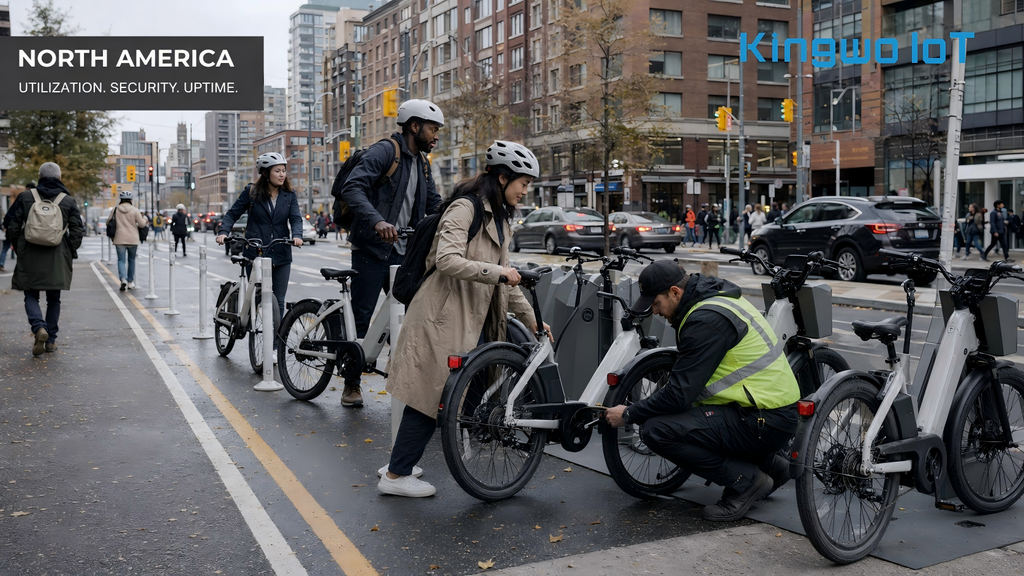
North America has already demonstrated that e-bikes can move beyond a niche recreational category. The U.S. Department of Energy reported that approximately 1.1 million e-bikes were sold in the United States in 2022, almost four times the 2019 volume. More recent nationwide public retail data remain fragmented, but industry measurements continue to show the category’s commercial importance. PeopleForBikes reported that e-bikes generated 63% of the growth in bicycle dollar sales between 2019 and 2023 and represented 20% of dollar sales in the measured bicycle market in 2023, despite accounting for only 4% of units.
The operational case is even clearer in shared mobility. According to NACTO, users made 150 million shared bike and scooter trips in member cities during 2025. Station-based e-bikes averaged 6.3 trips per vehicle per day in September 2025, compared with 3.4 for pedal bikes. High utilization is commercially attractive, but it also makes every hour of downtime, every unavailable battery and every missing vehicle more expensive.
For shared fleets, delivery operators and rental businesses, IoT therefore has to protect asset productivity. Location tracking is only the starting point. Operators need reliable vehicle identity, battery status, tamper detection, geofencing, movement alerts, maintenance triggers, utilization history and remote configuration. Data must flow into dispatch, customer-service and fleet-management systems through stable APIs rather than remain isolated inside a tracker vendor’s dashboard.
The consumer market produces a related but different requirement. E-bikes are relatively high-value, portable assets, so integrated security, theft recovery, service diagnostics and owner-facing applications can strengthen the product proposition after the initial sale. Battery and electrical-system safety are also shaping procurement. The U.S. Consumer Product Safety Commission has called on manufacturers to demonstrate compliance with applicable standards such as UL 2849 through accredited testing. Connected diagnostics can complement a certified electrical system by identifying abnormal conditions and maintenance needs, but they are not a substitute for compliant battery and system design.
North America’s regulatory structure is also fragmented across federal, state, provincial and municipal levels. A product that is technically an e-bike in one jurisdiction may face different access, registration or insurance treatment elsewhere. This increases the value of configurable speed policies, geofenced operating rules and auditable fleet data—especially for operators working across multiple cities.
The North American IoT value stack can therefore be summarized as security, uptime, serviceability and platform integration.
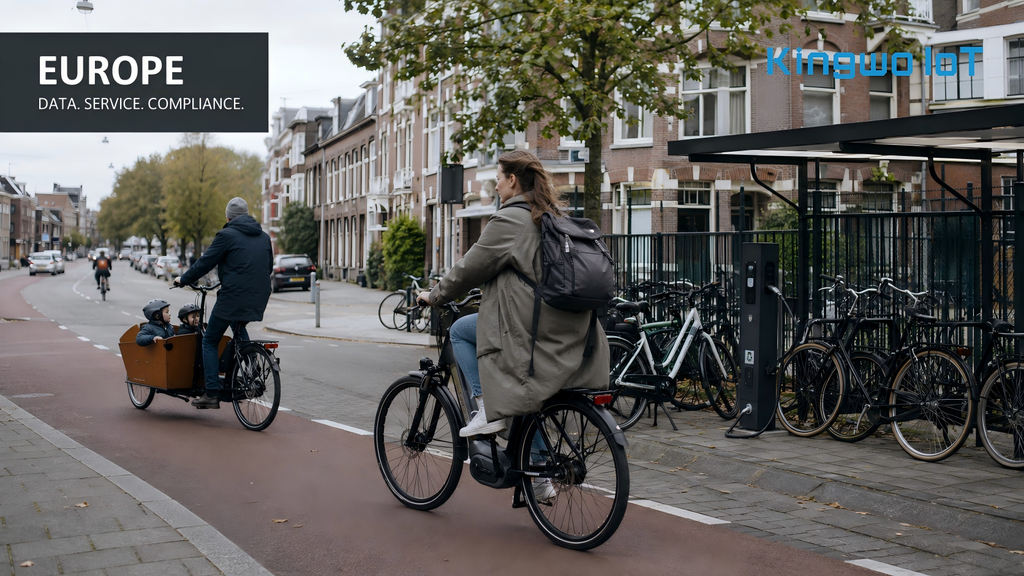
Europe combines industrial scale with regulatory depth. The 2026 European Bicycle Industry & Market Profile reported that 15.618 million bicycles and electrically power-assisted cycles were sold in Europe in 2025, with a combined sales value of €18.252 billion. Earlier category-specific data from CONEBI recorded 5.1 million e-bikes sold across the EU27 and the United Kingdom in 2023. Although the post-pandemic market has normalized, e-bikes remain a central part of the European cycling economy rather than a temporary growth category.
European policy is reinforcing that position. The European Declaration on Cycling commits institutions to improve cycling infrastructure, connections with public transport, secure parking and access to e-bike charging. The result is a market in which connected e-bikes increasingly intersect with company leasing, cargo-bike logistics, municipal bike sharing, insurance, service networks and multimodal transport.
However, the most important shift for IoT suppliers is not simply the number of connected vehicles. It is the changing legal treatment of the data those vehicles generate.
The EU Data Act has applied since 12 September 2025. It gives users of connected products greater rights to access, use and share the data generated through their use of those products. The European Commission explicitly identifies sensor data such as position, acceleration and speed as examples within scope. For an e-bike manufacturer, leasing company or fleet platform, this turns data access, portability and contractual clarity into product-design considerations—not merely back-office legal questions.
The Cyber Resilience Act raises the standard further. Its principal cybersecurity obligations for products with digital elements will apply from December 2027, while vulnerability-reporting obligations begin on 11 September 2026. Manufacturers will increasingly need security-by-design processes, controlled software updates, vulnerability handling and lifecycle support for connected hardware and related software.
This changes what “European-ready” IoT should mean. A connected e-bike architecture must support secure provisioning, role-based access, encrypted communications, controlled over-the-air updates, traceable firmware versions and clear data interfaces. Operators should be able to retrieve operational data without becoming permanently dependent on a closed platform. Manufacturers should know which party is the data holder, which party is the user and how personal location data is separated from non-personal machine data.
In Europe, IoT is moving from an optional feature toward a governed product lifecycle commitment.
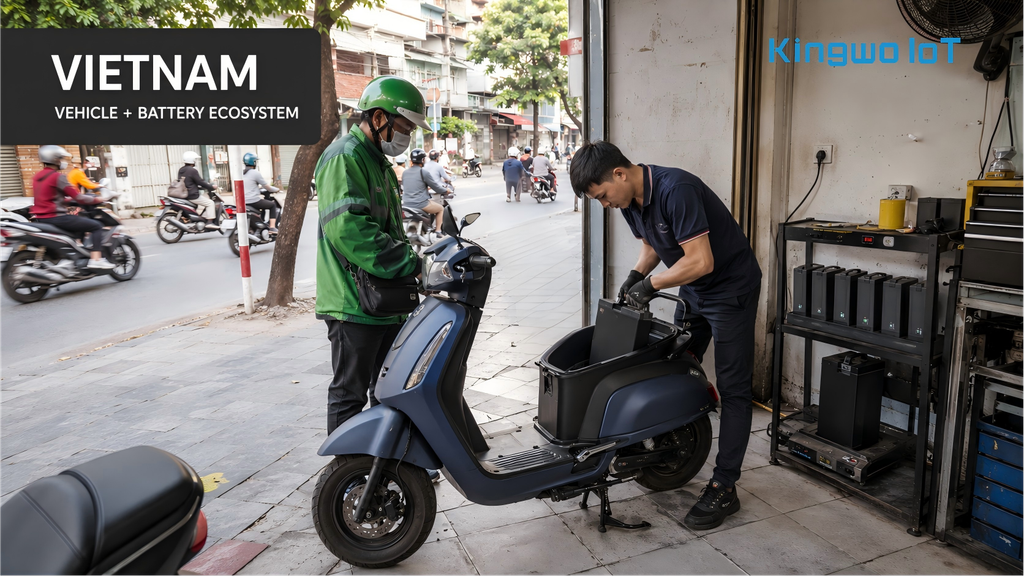
Vietnam is now one of the most consequential electric two-wheel markets outside China and India. The International Energy Agency reported that Vietnamese electric two-wheeler sales more than doubled to approximately 735,000 units in 2025, representing more than 20% of the country’s two-wheeler sales. Vietnam alone accounted for more than 30% of global electric two-wheeler sales growth that year.
Several forces are reinforcing the transition. Domestic manufacturers and incoming international brands are expanding model choice; lower-cost vehicles are bringing electric mobility closer to conventional scooter price points; and battery leasing can reduce upfront purchase cost. Charging and battery-swapping networks are also developing. At the policy level, Hanoi began implementing a phased low-emission-zone programme on 1 July 2026. Initial restrictions target defined central zones and time periods rather than imposing an immediate citywide prohibition, while the accompanying plan promotes electric public transport, public bicycles and e-bikes, charging sites and battery-swapping facilities. This staged approach still sends a clear long-term signal to manufacturers and fleet operators without overstating the speed of regulatory change.
Vietnam’s opportunity is structurally different from the premium e-bike opportunity in Europe. The dominant product is more likely to be an electric scooter or motorcycle with a traction battery, controller, dashboard and deeper vehicle electronics. The IoT device must therefore do more than report GNSS location. It may need to exchange data with the battery-management system and vehicle controller, manage lock or start authorization, support remote diagnostics and distinguish the identities of the vehicle, telematics unit and removable battery.
This is especially important when the battery is leased, swapped or serviced separately from the vehicle. A platform must know which battery is installed in which vehicle, its state of charge and health, how many cycles it has completed, where it moved and whether an abnormal event requires inspection. Without that identity mapping, battery swapping creates an inventory problem instead of an operating advantage.
At the same time, Vietnam is a scale- and cost-sensitive market. Hardware must deliver useful data without imposing an automotive-grade cost structure on every vehicle. Efficient reporting policies, event-based transmission, local data buffering, rapid device provisioning and localized applications matter as much as a long feature list. Interfaces such as CAN, RS485, UART and BLE may be required depending on the vehicle architecture, but the correct design is the minimum integration that reliably supports the operator’s commercial model.
In Vietnam, IoT can transform an electric scooter from a one-time hardware sale into a continuously managed vehicle-and-battery service.
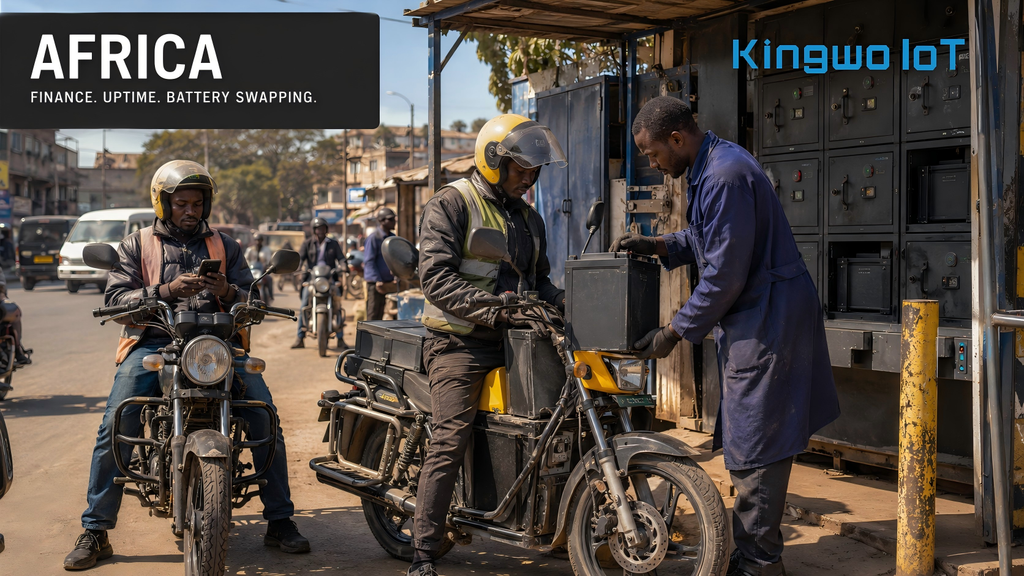
Africa’s electric two-wheeler market remains smaller in absolute terms, but its recent acceleration is strategically significant. The IEA estimates that sales grew from fewer than 1,000 electric two-wheelers in 2020 to around 70,000 in 2025. Uganda exceeded 30,000 sales in 2025, while Kenya passed 25,000 and electric models reached approximately 15% of new two-wheeler registrations.
This growth is being led by commercial mobility. Motorcycle taxis, delivery riders and other high-mileage users make purchase decisions around daily cash flow and total operating cost. The IEA estimates that Kenyan riders commonly earn around USD 10–15 per day and may spend 40%–60% of that income on fuel when operating a conventional motorcycle, while energy for an electric alternative can cost less than USD 2 per day. Those economics create a strong foundation for electrification, but many riders cannot purchase a vehicle and battery outright.
The result is an ecosystem built around lease-to-own finance, daily or weekly payments and battery swapping. In this model, IoT is not an accessory added after the vehicle is sold. It is part of the credit and operating infrastructure that makes the transaction possible.
A 2026 World Bank analysis of a Kenyan e-boda pilot illustrates the point. Real-time usage tracking and battery-swapping infrastructure supported payment enforcement and a lease-to-own model. During the limited eight-week study, researchers observed a 37% productivity increase and a doubling of energy efficiency after the business-model transition. The findings should not be generalized to every market without further evidence, but they demonstrate how telemetry can influence both asset economics and worker behavior.
For African commercial fleets and financiers, the IoT priority stack includes proof of utilization, payment-linked authorization, theft and tamper alerts, vehicle recovery, battery inventory, swap history, energy cost, maintenance scheduling and residual-value evidence. The technical design must also account for inconsistent coverage, variable power availability, dust, water, vibration and long service lives. Offline event storage, low-data transmission, multi-network connectivity, robust enclosures and remote configuration are operational requirements rather than premium features.
There is also a governance responsibility. When telemetry affects whether a rider can work, qualify for ownership or access finance, data accuracy and transparent rules become commercially and ethically important. An erroneous location, missed payment event or remote-disable command can directly affect a person’s income. Reliable audit trails and carefully designed authorization policies are therefore essential.
In these markets, IoT is becoming the trust layer connecting the rider, vehicle, battery, operator and financier.
The same GPS unit cannot optimally serve a European leased EPAC, a North American shared e-bike, a Vietnamese electric scooter and a Kenyan lease-to-own e-motorcycle. Their power systems, interfaces, duty cycles, coverage conditions and legal obligations are too different. A global strategy therefore requires a modular architecture rather than a single global SKU forced into every use case.
The first layer is identity. Vehicle ID, battery serial number, telematics device ID, IMEI, customer account and fleet assignment should be separately maintained and securely mapped. This enables battery swaps, warranty investigation, device replacement and ownership transfer without corrupting the operating history.
The second layer is regional connectivity. BLE can support local commissioning, rider access and service diagnostics. GNSS provides independent location. Cellular technology—whether LTE Cat 1, LTE-M, NB-IoT or another region-appropriate profile—should be selected according to coverage, mobility behaviour, latency, power budget, roaming and network-lifecycle requirements. GSMA expects more than 130 legacy 2G and 3G networks to retire by 2030, while African shutdowns are likely to be more gradual and selective. Long-life products therefore need region-specific radio planning rather than a lowest-cost modem decision.
The third layer is vehicle intelligence at the edge. The device should recognize business-relevant events—unauthorized movement, abnormal voltage, crash-like acceleration, battery removal, geofence entry, long inactivity or communication failure—and transmit them according to priority. Local buffering is critical when coverage disappears. Configurable reporting avoids wasting power and data on low-value location points.
The fourth layer is open integration with controlled security. Fleet operators and OEMs need APIs, device-to-private-server options or white-label platforms according to their business model. Openness does not mean uncontrolled access: authentication, encryption, permissions, firmware signing, audit logs and vulnerability management must remain part of the design.
Finally, the hardware portfolio should reflect different energy and installation conditions. A hidden, self-powered security device solves a different problem from a vehicle-powered telematics control unit connected to a BMS. Separating these roles allows OEMs and operators to select the correct balance of cost, concealment, data depth and control.
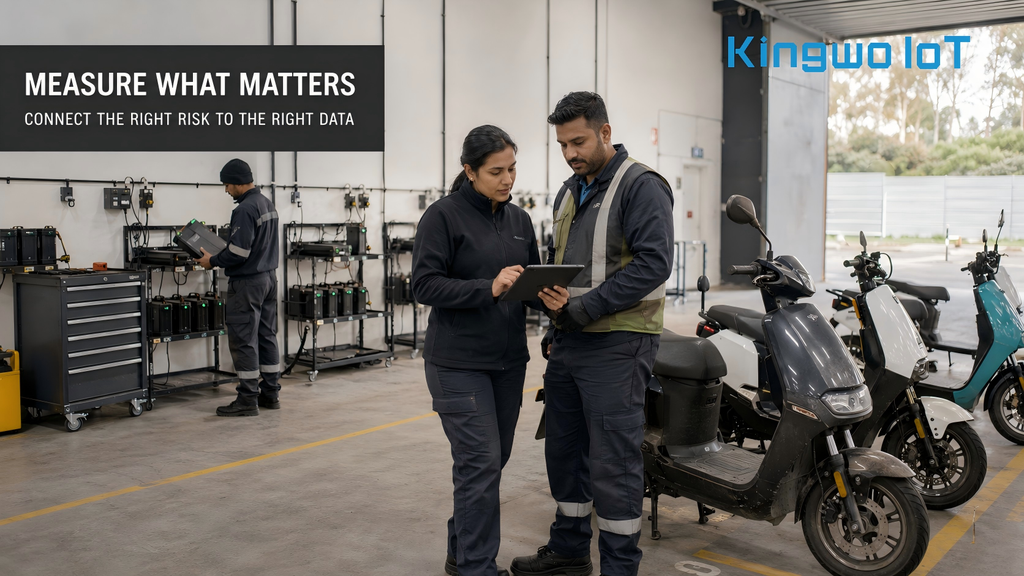
The business case for connected two-wheelers should be evaluated through operational results, not the number of features in a specification sheet. Relevant indicators include active vehicles as a percentage of fleet, trips per vehicle per day, downtime, recovery rate, battery swaps per day, energy cost per kilometre, abnormal battery events, maintenance cost per 1,000 kilometres, payment compliance, data-delivery success and the time required to provision or replace a device.
The weighting changes by market:
The IoT architecture should be designed backward from those metrics.
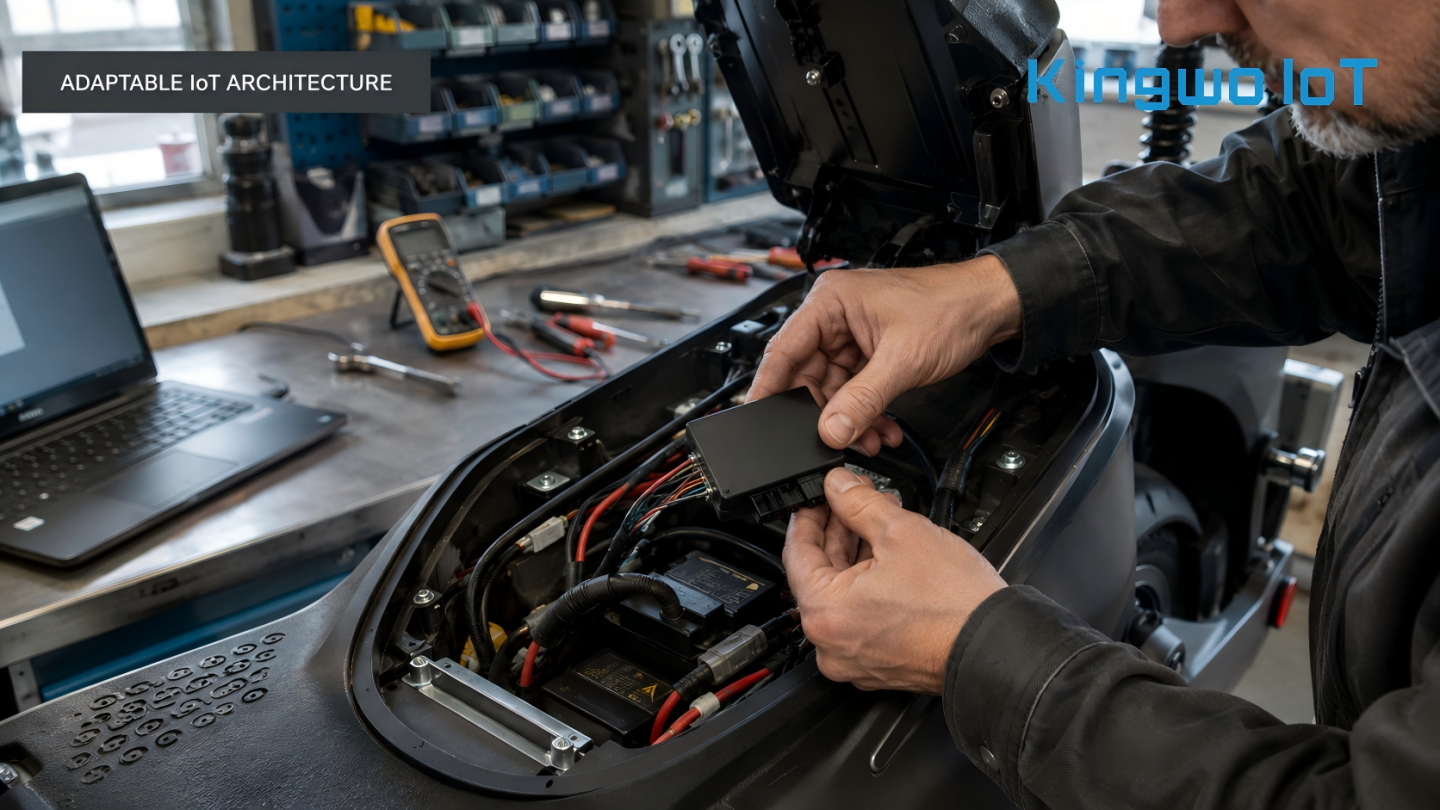
From Kingwo IoT’s perspective, the global opportunity is larger than a “GPS tracker for e-bikes.” The real requirement is an adaptable connected-vehicle architecture that can combine GNSS, cellular and BLE connectivity with vehicle or battery interfaces, configurable event logic, API integration, private-server communication and OEM/ODM customization.
That architecture may take the form of a concealed security unit, a vehicle-powered telematics controller, a battery-linked device or a combined fleet-management solution. The correct form depends on the market’s primary risk: theft, downtime, regulatory exposure, battery circulation, financing or payment control.
The winners in electric two-wheel mobility will not necessarily be the companies that collect the most data. They will be the companies that convert the right data into lower operating cost, stronger asset control, safer products and better customer outcomes—while respecting the regulatory and social context in which each vehicle operates.
The strategic question is no longer whether the electric two-wheeler should be connected. It is which business risk that connection must remove, in which market, and for whom.
By Kailiang Tang
Acting Marketing Director, Kingwo IoT
 news
news
 news
news
 news
news
 news
news
 news
news
 news
news
 news
news
 news
news

English

French

Portuguese

Spanish