
In November 2026, the Baja California Peninsula will become more than a stage for one of the world’s most demanding off-road races. It is also expected to become a real-world testing ground for the next generation of electric mobility, AI and vehicle telematics.
The 59th SCORE Baja 1000 is scheduled for November 9–15, 2026, with both the start and finish in Los Cabos, Mexico. For the first time in the race’s history, the course will run entirely through Baja California Sur—across deserts, mountains and coastal terrain. According to SCORE International, the event will bring together competitors from around the world in one of the toughest environments in off-road motorsport. Los Cabos to Host Start and Finish of the BFGoodrich Tires 59th SCORE Baja 1000 - SCORE International
But one team plans to test much more than speed.
Pilot Racing plans to enter electrically powered off-road motorcycles equipped with an AI-enabled telemetry and energy-management system developed through cooperation between General Dynamics Information Technology (GDIT) and Amazon Web Services (AWS).
Unlike conventional GPS tracking, the proposed system will collect data from both the motorcycle and the rider. The information is expected to help the support team predict:
Instead of waiting for a low-battery warning or a mechanical problem, the system aims to identify risks before they become obvious.
This is a significant change in how vehicle data is used.
Traditional tracking tells a team where a vehicle is. Predictive telematics can help explain what is happening, what may happen next and what action the team should take.
The Baja desert is an ideal real-world testing ground because it brings together many of the same challenges faced by electric fleets operating in remote or infrastructure-limited environments. Communication networks can be unstable or completely unavailable, while long distances between service points make maintenance, rescue, and battery replacement much more difficult.
At the same time, extreme temperatures, rapidly changing terrain, continuous vibration, dust, and physical impact place heavy pressure on both the vehicle and its connected hardware. Energy consumption also becomes harder to predict in these conditions, especially when riders face sand, rocks, elevation changes, or sudden route adjustments.
For fleet operators, these challenges are not only about performance, but also about safety and visibility. When a rider has an accident, stops unexpectedly, or loses connection in a remote area, the ability to locate them quickly and understand the vehicle’s real-time status becomes critical. This is why desert racing provides a powerful test environment for telematics, battery monitoring, remote diagnostics, and emergency response solutions.
In a city, a delayed data transmission may be inconvenient. In the desert, it can affect route planning, battery deployment and rider safety.
This is why reliable edge data collection, local storage and communication recovery are so important. When a vehicle temporarily loses its network connection, its IoT hardware must continue recording critical information and upload the stored data after communication is restored.
The device installed on the vehicle becomes more than a location tracker. It becomes the link between the motorcycle, the rider, the support team and the cloud.
The Pilot Racing project is expected to send motorcycle and rider telemetry to AWS infrastructure for analysis. The objective is to provide the team with predictive recommendations about pit stops and battery changes.
Future versions could also integrate rider-health information. By examining movement patterns, elevation changes and unusually long stops, the system may help identify whether a rider is simply resting, experiencing a technical problem or facing an emergency.
This same concept can extend far beyond racing.
Delivery fleets, shared electric motorcycles, rental E-bikes, outdoor patrol vehicles and emergency-response teams face similar questions every day:
The value of telematics is not created by collecting more data. It is created by turning the right data into faster and more reliable decisions.
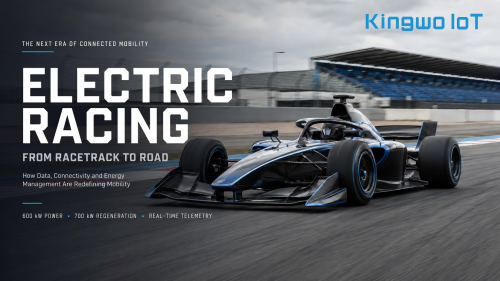
Although the Baja project involves electric off-road motorcycles rather than conventional pedal-assist E-bikes, its technological direction is highly relevant to the wider electric two-wheeler industry.
The next generation of connected E-bikes and electric motorcycles will require more than basic GPS coordinates. Manufacturers and fleet operators will increasingly need integrated systems capable of supporting:
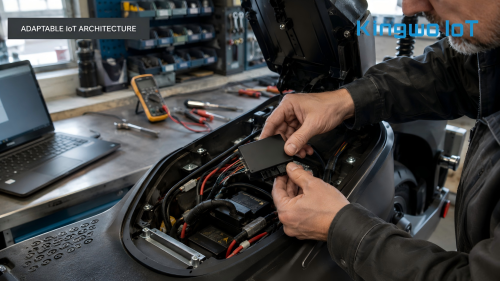
The hardware must also be capable of operating under vibration, temperature changes, dust, moisture and intermittent network coverage.
At Kingwo IoT, we believe the future of E-mobility will be built around connected decision-making.
GPS remains the foundation, but location alone is no longer enough. A truly connected vehicle should be able to combine positioning, vehicle status, energy information and operational events—and deliver that information to the people who need to act on it.
For E-bike and electric motorcycle manufacturers, this means developing telematics hardware that can integrate with controllers, batteries, displays and third-party fleet platforms through flexible communication interfaces and APIs.
For fleet operators, it means moving from reactive management to proactive operations: identifying unusual stops, maintenance risks, unauthorized movement and potential energy shortages before they interrupt service.
For riders, it means better visibility, faster assistance and greater protection in both urban and remote environments.
The 2026 Baja 1000 has not yet taken place, and the results of this planned technology test remain to be seen. However, the direction is already clear:
The future of electric mobility will not be defined only by how far a vehicle can travel. It will also be defined by how intelligently the vehicle can communicate, predict and respond.
When electric motorcycles enter the desert, telematics is no longer just a management tool.
It becomes part of the vehicle’s operational and safety infrastructure.
By Kailiang Tang
Acting Marketing Director, Kingwo IoT
 news
news
 news
news
 news
news
 news
news
 news
news
 news
news
 news
news
 news
news

English

French

Portuguese

Spanish