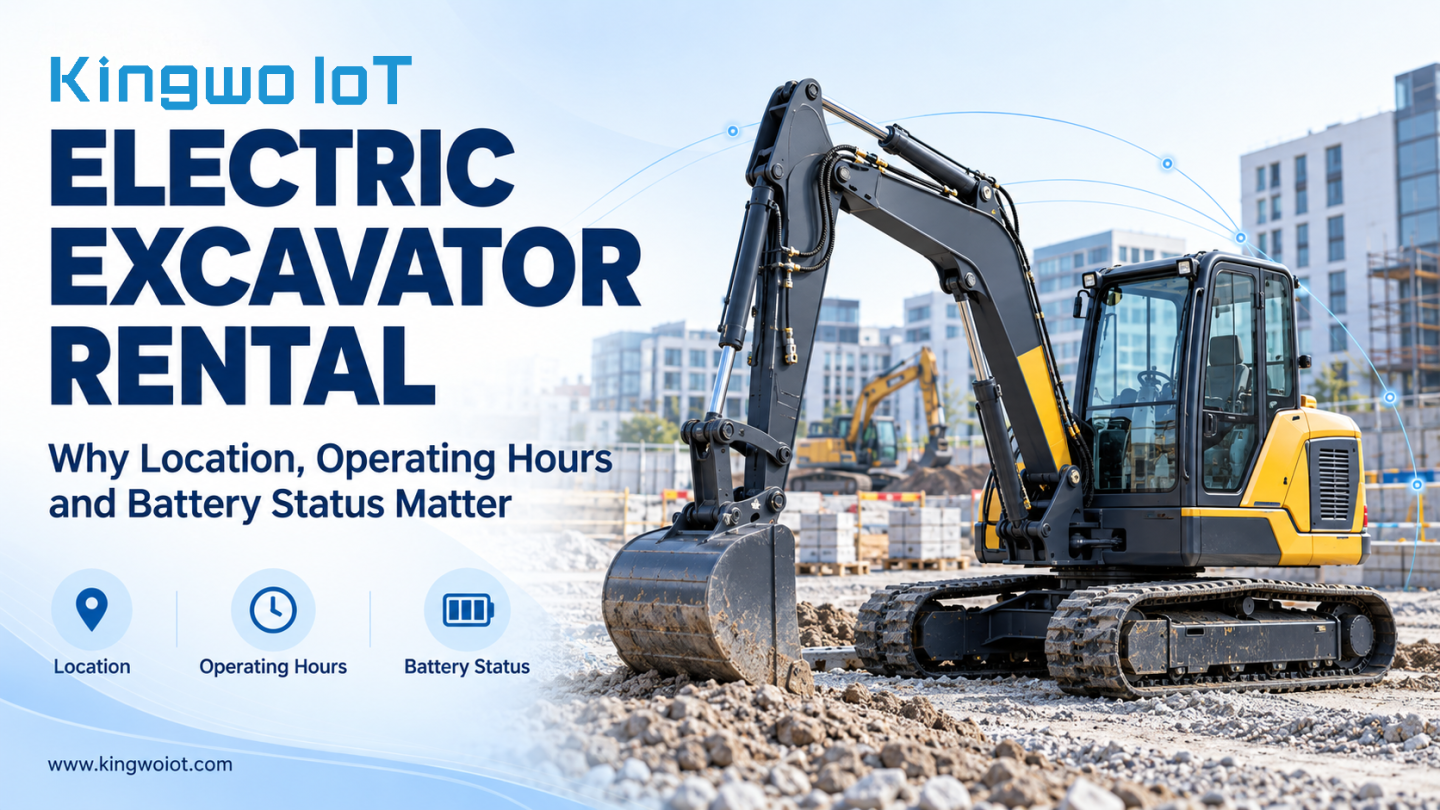

Electric excavators bring a practical question to equipment rental: how does a rental company know whether a machine is ready for its next customer?
A booking calendar can show when an excavator is due back. It cannot, by itself, confirm where the machine is, how many hours it has operated or whether it has enough charge for the next assignment. For rental businesses managing equipment across several construction sites, those details can influence dispatch, maintenance and customer conversations.
Boels Rental’s Dutch catalogue provides a useful starting point. The company lists a 1.9-tonne battery-powered excavator for hire, describing applications in urban areas, enclosed spaces and locations with restrictions on engine emissions or noise. Electric compact excavation is already part of an established rental offering. [1] Boels
For rental operators considering similar equipment, the management challenge extends beyond purchasing an electric machine. It involves collecting the information needed to keep that machine available, correctly accounted for and ready to work.
The Boels product page includes a commercially relevant detail: for machines equipped with an hour counter, its published rental information bases daily rates on eight operating hours and weekly rates on 40 operating hours, with a surcharge for additional use. These conditions should be checked against the specific booking and rental agreement. [1] Boels
The implication for rental management is straightforward. Where a contract includes an operating-hour allowance, a reliable usage record helps both parties understand how the equipment was used.
Consider an illustrative rental with a 40-hour weekly allowance. If a machine records 47 hours during that period, the rental team needs a clear record to review the additional seven hours against the agreement. Readings taken at dispatch and return remain important; remote monitoring can provide visibility between those two events.
That information can also help a rental company identify equipment approaching a service interval while it is still on hire.
A machine’s recorded booking location and its actual position may differ. Equipment can move between work areas, remain on a completed site awaiting collection or be transferred under an agreed arrangement.
For dispatch teams, current location information can help answer everyday questions: which machine is closest to the next job, where should the collection driver go, and has an asset left its expected operating area?
Boels describes this use of connectivity in its own fleet. Its official article explains that MyBoels can display GPS location and running hours for machines equipped with telematics, with additional information available where supported. [2] Boels Corporate
A useful tracking deployment should make the age of the location record visible. A position uploaded several hours ago should not be mistaken for a current location, particularly when a machine is being collected, or an unexpected movement is being investigated.
Geofence notifications can support that investigation, but an alert still needs context. A scheduled collection and an unauthorized movement may both involve a machine leaving the same boundary.
Before selecting a monitoring device, rental companies should establish what their hour records represent.
Key-on time, motor-running time and productive digging time measure different activities. A machine may be powered on while waiting for instructions, and an electrically powered system may remain active without the excavator performing useful work.
For rental billing, the relevant measurement should match the contract and the agreed machine counter. For maintenance, it should follow the manufacturer’s service requirements. For utilization analysis, additional signals may be needed to distinguish availability from actual work.
This distinction matters when adding aftermarket hardware. A terminal connected to a power or ignition signal may provide a useful activity record, but that record should not automatically be presented as equivalent to the machine’s official operating-hour counter.
A pilot installation should compare the collected data with the machine display and establish any differences before the information is used commercially.
An electric excavator can be physically available and still need charging before it can be sent to another customer.
Imagine a machine returned late in the afternoon and booked for delivery the following morning. If charging stops overnight, the problem is more useful to discover before the transport vehicle arrives.
Volvo Construction Equipment’s My Equipment service illustrates the operational relevance of this information. Its official description includes machine hours, location, power consumption and remote charging status, as well as notifications when charging is unexpectedly interrupted. [3] Volvo CE United States
For a rental business, these functions suggest a practical workflow: check the machine’s available battery information before confirming dispatch, assign responsibility for charging and investigate interruptions early.
However, battery voltage alone should not be treated as an accurate indication of remaining working time. State of charge, workload, temperature and machine condition can all affect an operating plan. Any remaining-runtime estimate needs a suitable technical basis.
A rental fleet may include diesel excavators, electric mini excavators, loaders and other equipment from several manufacturers. Some machines may already have accessible OEM telematics, while others may offer limited connectivity.
The first step is to identify the information already available. Adding another device is most useful when it fills a defined gap, such as location coverage on an older asset or transmission of accessible machine signals to the rental company’s existing platform.
The following distinctions help keep a project realistic:
| Management requirement | Possible data source | What needs confirmation |
|---|---|---|
| Equipment location | GNSS tracking terminal | Installation position, coverage and reporting interval |
| Operating-hour records | Machine counter, controller data or activity input | Meaning of the signal and agreement with the machine counter |
| Battery state of charge | BMS, controller or OEM data service | Accessible interface, protocol and available fields |
| Charging status | Machine or charging-system data | How charging and interruption events are identified |
| Fleet reporting | Existing platform or an integration service | Supported protocols, device identity and reporting requirements |
CAN or RS485 connectivity can provide a route to machine data, but the presence of an interface does not guarantee access to every required parameter. Protocol documentation, permission to access the data and testing on the specific machine remain necessary.
A useful pilot begins with a few operational questions.
Can the dispatch team locate the machine when needed? Do the uploaded hours match the selected reference counter? Is battery information available and correctly interpreted? Does data reach the platform consistently during normal operation?
Testing should include working, parked, and charging conditions, as well as temporary loss of network coverage. Installation should also be reviewed for auxiliary power compatibility, vibration, water exposure and service access.
The results provide a basis for deciding which functions are ready for wider deployment and which need further integration.
Kingwo IoT welcomes enquiries from construction equipment rental companies, distributors and fleet-platform providers evaluating tracking and connectivity for their machinery.
A project can begin with location tracking and expand to operating or battery data where suitable interfaces and protocols are available. The proposed hardware and integration approach should follow the machine requirements and the information the rental business actually needs.
For an initial review, provide the equipment brand and model, auxiliary supply voltage, available interface documentation, required data fields and intended testing quantity. Companies with an existing platform can also share their device connection requirements.
By Kailiang Tang
Acting Marketing Director, Kingwo IoT
 news
news
 news
news
 news
news
 news
news
 news
news
 news
news
 news
news
 news
news

English

French

Portuguese

Spanish