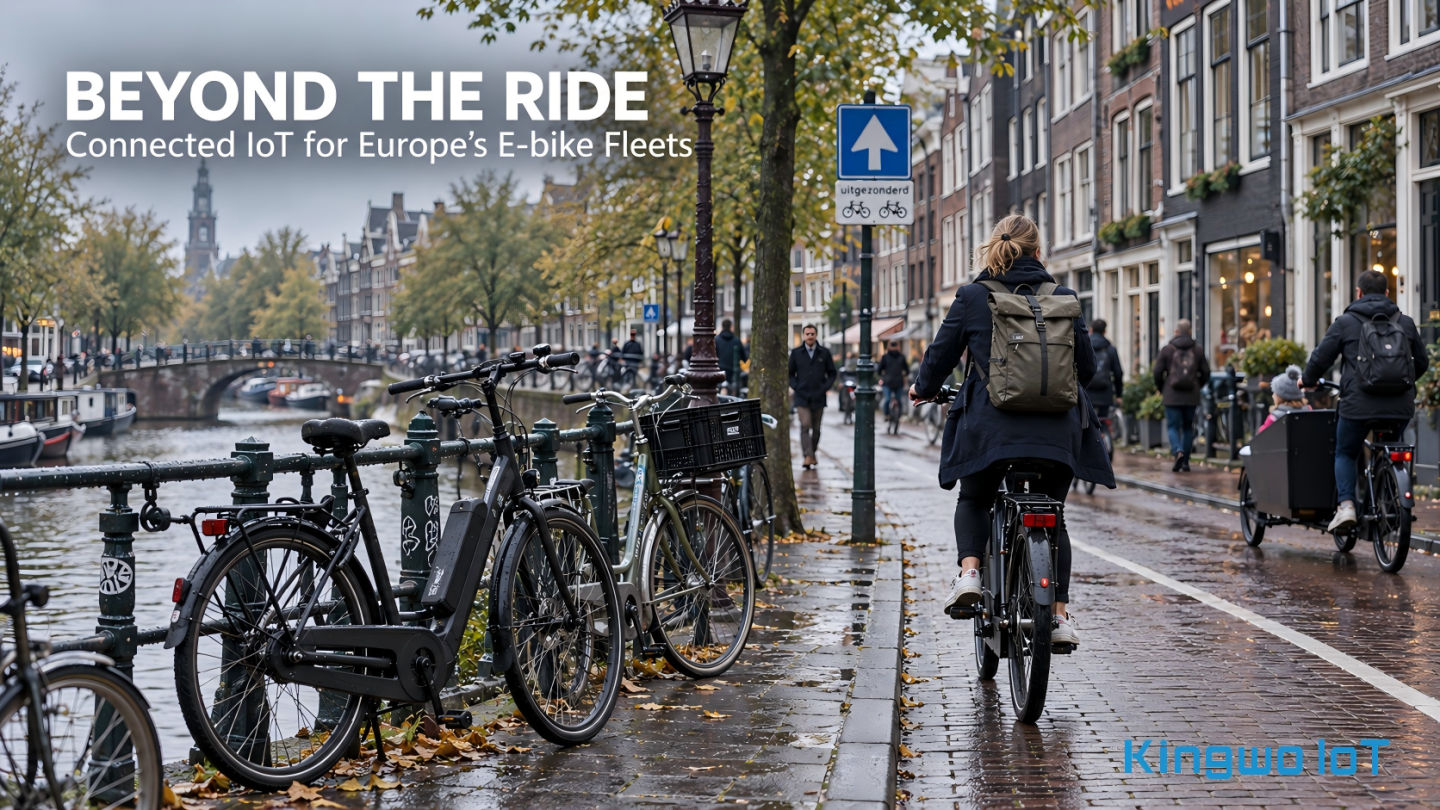

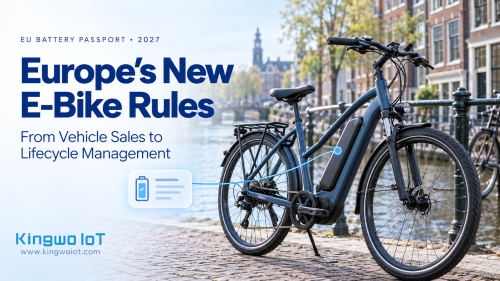
From the Netherlands to the wider European market, the E-bike is evolving from a standalone vehicle into a connected, manageable and serviceable digital asset.
The Netherlands no longer needs to prove that the E-bike has a place in everyday mobility. The more important question is what happens after hundreds, thousands or even tens of thousands of electric bicycles enter daily operation.
In 2025, approximately 391,300 E-bikes were sold in the Netherlands, accounting for 49% of all new bicycle sales and generating 73% of total bicycle-market revenue. The average E-bike price also increased to approximately €2,870. These figures reveal an important shift: even as overall bicycle sales fluctuate, the E-bike remains the commercial centre of the Dutch bicycle industry. Micromobility Industries
An E-bike is no longer simply a bicycle with a battery and motor. It is a valuable mobile asset—one that may belong to an individual rider, an employer, a leasing company, a delivery fleet or a shared-mobility operator.
That changes what the European market needs from the technology inside it.
The European E-bike industry has spent years improving motors, batteries, frames and riding performance. Those developments made electric cycling more practical and helped it become part of mainstream transportation.
The next phase will be shaped by a different set of questions:
These are no longer secondary considerations. They directly affect vehicle utilization, loss rates, customer experience, maintenance efficiency and the total cost of operating an E-bike fleet.
This transition is also supported at the policy level. The European Declaration on Cycling, signed by the European Parliament, the Council and the European Commission in 2024, formally recognizes cycling as a sustainable, accessible and affordable mode of transport with significant economic value. Its priorities include stronger cycling infrastructure, secure parking, investment, industrial development and better mobility data. European Commission
The direction is clear: Europe is not treating cycling as a temporary lifestyle trend. It is becoming part of the continent’s long-term mobility infrastructure.
The higher the value of an E-bike, the greater the financial impact when it is stolen, misused or left outside an authorized operating area.
Statistics Netherlands estimated that approximately 928,000 bicycle-theft incidents occurred in the country in 2023, representing an increase of around 30% compared with 2021. This figure is based on victim reporting and therefore differs substantially from police-registered cases, but it illustrates the real scale of the problem beyond formal reports. Statistics Netherlands
For an individual rider, theft is already disruptive. For an operator managing 500 rental or subscription E-bikes, it becomes an operational and financial risk that must be measured and controlled.
A conventional lock remains essential, but it cannot tell an operator whether a vehicle has moved unexpectedly, crossed a defined operating boundary or disappeared from its assigned location. A basic GPS tracker can provide coordinates, but location alone does not create a complete fleet-management system.
The European market increasingly needs a deeper connection between the vehicle, the rider, the operator and the management platform.
The difference between tracking an E-bike and connecting an E-bike is significant.
Tracking answers one question:
Where is the vehicle?
A connected IoT architecture can help answer a broader set of operational questions:
This matters particularly for subscription fleets, corporate leasing, last-mile delivery, tourism rental and shared-mobility operations. In these environments, the E-bike is not only a product sold once. It is an asset that must remain visible, available and manageable throughout its operational life.
The more mature the European E-bike market becomes, the more value will move from the initial vehicle sale toward services such as leasing, insurance, maintenance, recovery and connected fleet management.
This is the market position behind Kingwo IoT’s LT420. (Contact us through LT42 Product Page)
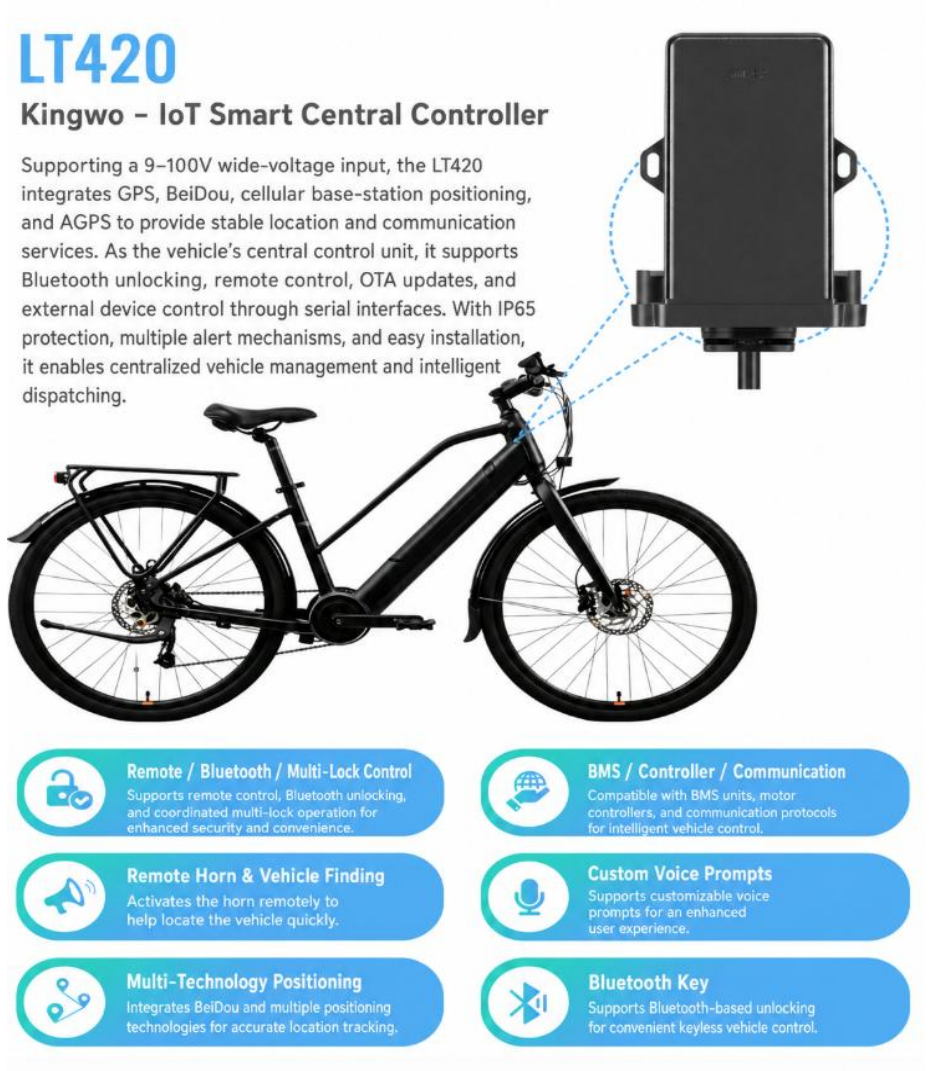
LT420 is designed not merely as an add-on location tracker, but as an IoT control and connectivity terminal for E-bikes, electric motorcycles and related light electric vehicles. It is intended for manufacturers, fleet operators, rental businesses, mobility platforms and solution providers that require greater control over their vehicles.
The device combines positioning and vehicle connectivity with Bluetooth-based vehicle access. It supports RS485 communication, allowing it to participate in a broader vehicle architecture rather than operating as a completely isolated tracker.
LT420 can also work with an external speaker for audible vehicle prompts, locating assistance and security alerts. Through integration with a customer’s management platform, vehicle information can connect to fleet workflows, user management, and operational rules.
For customers with established software systems, Kingwo IoT can support protocol adaptation and private-platform integration. Hardware configuration, wiring, and functionality can also be evaluated based on the vehicle model and project requirements.
The result is a more flexible foundation for several European applications:
LT420 does not attempt to replace every component inside an E-bike. Its role is to help connect the vehicle’s physical operation with the operator’s digital management environment.
The Netherlands represents more than a large E-bike market. It provides a preview of what other European markets may become as electric cycling matures.
Vehicle values are high. Leasing and subscription models are well established. Riders expect convenient digital services. Operators need stronger asset protection, while manufacturers are looking for new ways to differentiate beyond battery capacity and motor performance.
This makes the Netherlands an ideal market for moving the conversation beyond “Does the E-bike have GPS?”
The better questions are:
- Can the vehicle become part of the operator’s digital system?
- Can access, location and abnormal events be managed together?
- Can the same IoT architecture support different vehicles and business models?
These questions are increasingly relevant not only in the Netherlands, but also across Germany, France, Belgium, Italy, Spain and the wider European mobility market.
At Kingwo IoT, we believe the next generation of E-bike competition will not be decided by hardware specifications alone.
The strongest vehicles will be those that can connect riders, operators and service networks through a practical digital architecture. Positioning will remain important, but it will become one part of a wider operational system covering vehicle access, asset protection, platform connectivity and fleet visibility.
For European manufacturers and operators, the opportunity is not simply to add another electronic component. It is to make each E-bike easier to manage throughout its complete operational lifecycle.
By Kailiang Tang
Acting Marketing Director, Kingwo IoT
 news
news
 news
news
 news
news
 news
news
 news
news
 news
news
 news
news
 news
news

English

French

Portuguese

Spanish