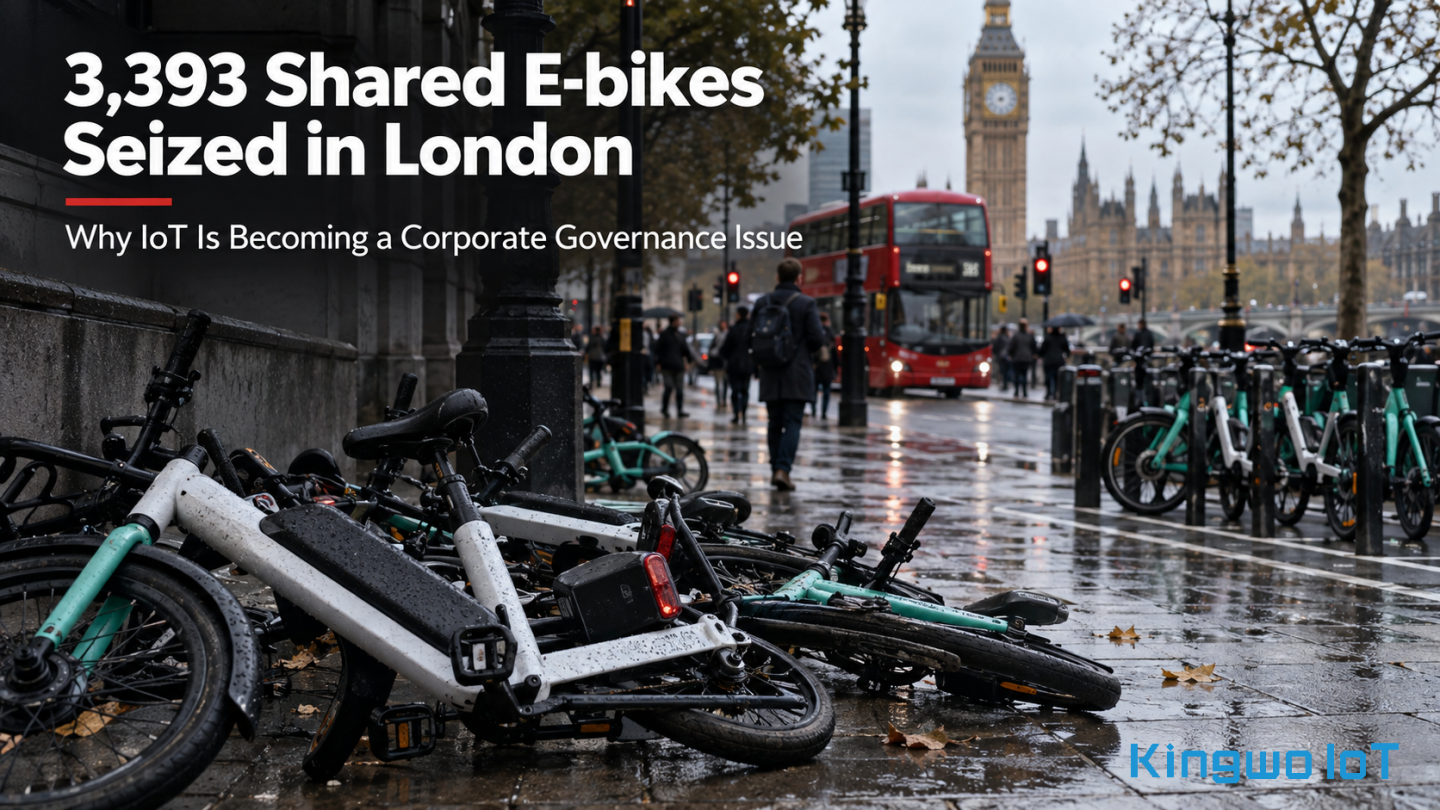

London’s shared e-bike market is facing a problem that goes far beyond improper parking.
According to an investigation published by The Guardian, London councils have seized at least 3,393 shared e-bikes so far in 2026 because they were abandoned or parked in locations that obstructed roads, pavements and public access. The number is already 23% higher than the total recorded throughout 2025. Lime accounted for more than 2,000 of the seized vehicles, followed by Forest with 978 and Voi with 103.
The figures reflect growing tension between the rapid expansion of shared mobility and the ability of operators to manage increasingly large connected fleets. For the IoT industry, the significance of this story is not limited to where the bicycles were parked. It raises a broader question about whether connected-mobility companies have developed the technical and operational systems required to remain accountable for every vehicle they place in a city.
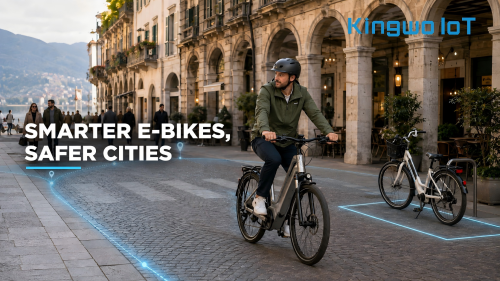
Dockless e-bikes have become an established part of London’s transport network. Approximately one in every ten of the city’s 1.5 million daily cycling journeys is now made using a dockless e-bike, according to figures cited by The Guardian. Their popularity demonstrates that shared e-bikes are no longer an experimental transport service. They have become part of the daily mobility system used by residents, commuters and visitors.
However, the larger the fleet becomes, the more visible its operational weaknesses become. An individual bicycle parked incorrectly may appear to be an isolated case of poor user behaviour. When thousands of vehicles are repeatedly found blocking pavements, entrances, parking spaces and accessible routes, the issue becomes structural. It begins to affect pedestrian safety, urban accessibility, public confidence and the relationship between operators and city authorities.
Shared-mobility companies have argued that the supply of designated parking spaces has not kept pace with the growth in demand. This is a legitimate concern, and cities cannot encourage shared transport while failing to provide sufficient supporting infrastructure. Nevertheless, limited parking infrastructure does not remove the operator’s responsibility to monitor its vehicles, enforce parking rules and respond quickly when a bicycle becomes an obstruction.
London is now moving towards a more unified licensing framework for dockless e-bike operators. New regulatory powers are expected to allow Transport for London to establish clearer requirements concerning parking, safety and accessibility. This suggests that future market access may depend not only on fleet size or ridership, but also on whether operators can demonstrate reliable and responsible fleet management.

The London case exposes an important limitation in the way many companies continue to view vehicle tracking. A location marker on a digital map may show the approximate position of a bicycle, but that information alone cannot determine whether the vehicle is parked correctly, remains available for use or requires intervention.
Effective shared-fleet management depends on the quality and context of the data received from each vehicle. Operators need accurate positioning to determine whether a bicycle is inside an authorized parking zone. They also need vehicle-status information to understand whether the bicycle is upright, locked and stationary, as well as movement alerts that can identify when a parked vehicle has been relocated or tampered with. When a vehicle remains in one location for an unusual period or stops reporting data entirely, the platform should be able to distinguish between normal parking, a technical fault and a potential operational incident.
This is why geofencing has become increasingly important to shared-mobility operations. A properly configured geofence can help prevent users from ending a ride outside an approved area, while Bluetooth-based verification and vehicle-sensor data can provide additional confirmation where satellite positioning is affected by buildings or other urban conditions. The same system can also generate alerts for unauthorized movement, prolonged inactivity, disconnection or abnormal device behaviour.
These capabilities turn location data into operational information. Without them, operators may only discover a problem after a member of the public reports it or a local authority removes the vehicle. By that point, the issue has already become a visible failure of fleet management.
At the same time, another transition is taking place across the European IoT market. Connected-device security is no longer being treated solely as a technical matter for engineers. It is increasingly becoming a question of product governance, regulatory responsibility and corporate risk.
The European Union’s Cyber Resilience Act introduces cybersecurity requirements for products with digital elements and places greater responsibility on manufacturers throughout the product lifecycle. The regulation reflects a broader shift in how Europe approaches connected products: security must be considered during product design, supported after the product enters the market and maintained through appropriate vulnerability handling and software updates.
For shared-mobility operators, the implications extend beyond conventional cybersecurity. IoT terminals installed in e-bikes may support vehicle identification, location reporting, Bluetooth unlocking, ride termination, battery monitoring, remote control and maintenance planning. If the device produces inaccurate data, operates on outdated firmware or communicates unreliably, the consequences may affect physical fleet operations and information security.
A fleet operator therefore needs to know which device is installed in each vehicle, which firmware version it is running, when its configuration was last changed and whether it is communicating normally. Device identities, software versions and operational records must remain traceable throughout the fleet. When a fault or vulnerability is identified, the company must be able to locate the affected devices and update them without recalling every vehicle from the street.
This is the point at which IoT security becomes corporate governance. The responsibility no longer ends with preventing unauthorized access. It includes ensuring that management can trust the data used to operate the fleet and can demonstrate how connected assets are monitored, maintained and controlled.

The shared e-bike industry cannot separate device management, data management and fleet operations. They are parts of the same operational system.
At the device level, every IoT terminal should have a verifiable identity and a clearly managed configuration. Hardware and firmware versions should be recorded, communication status should be monitored, and remote updates should be available when settings or software need to be changed. This becomes particularly important when fleets include thousands of vehicles deployed across multiple cities.
At the data level, location and vehicle-status information must be accurate, continuous and sufficiently detailed to support real decisions. The objective is not simply to collect more data, but to ensure that important events are recorded and delivered at the appropriate time. Operators must be able to identify abnormal movement, communication loss, unauthorized parking and potential device failure without creating an excessive volume of meaningless alerts.
At the operational level, that information must lead to action. A fleet-management platform should help teams identify improperly parked vehicles, prioritize recovery tasks, dispatch maintenance personnel and analyze repeated problem areas. Historical data can also help operators adjust parking zones, improve vehicle distribution and provide evidence when responding to regulators or resolving disputes.
A connected vehicle that only transmits coordinates is still being tracked. A connected vehicle whose identity, condition, software, location and operational history can be managed is part of a governed fleet.
The first stage of the shared-mobility market was largely defined by expansion. Operators competed to enter new cities, deploy more vehicles, attract users and increase the number of completed rides. That approach helped establish shared e-bikes as a recognized form of urban transportation, but it also created fleets that are increasingly difficult to manage through manual operations alone.
The next stage will be defined by control and accountability. Cities will likely demand better parking compliance, clearer operational records and faster responses to public complaints. Users will expect reliable vehicles and more accurate parking guidance, while regulators will place greater emphasis on product security and lifecycle management. Operators that cannot demonstrate control over their connected assets may face fines, vehicle seizures, reputational damage or restrictions on their ability to operate.
This transition will also change the way IoT hardware is evaluated. The initial purchase price of a terminal will remain important, but it cannot be the only consideration. Positioning accuracy, communication stability, power consumption, protocol compatibility, device identification, firmware maintenance and private-server integration all influence the long-term cost of managing a connected fleet.
A low-cost device that provides incomplete data or cannot be updated efficiently may eventually create much higher expenses through vehicle recovery, maintenance visits, service interruptions and regulatory disputes. For fleet operators, the real value of an IoT terminal lies in the quality of the operational decisions it enables.
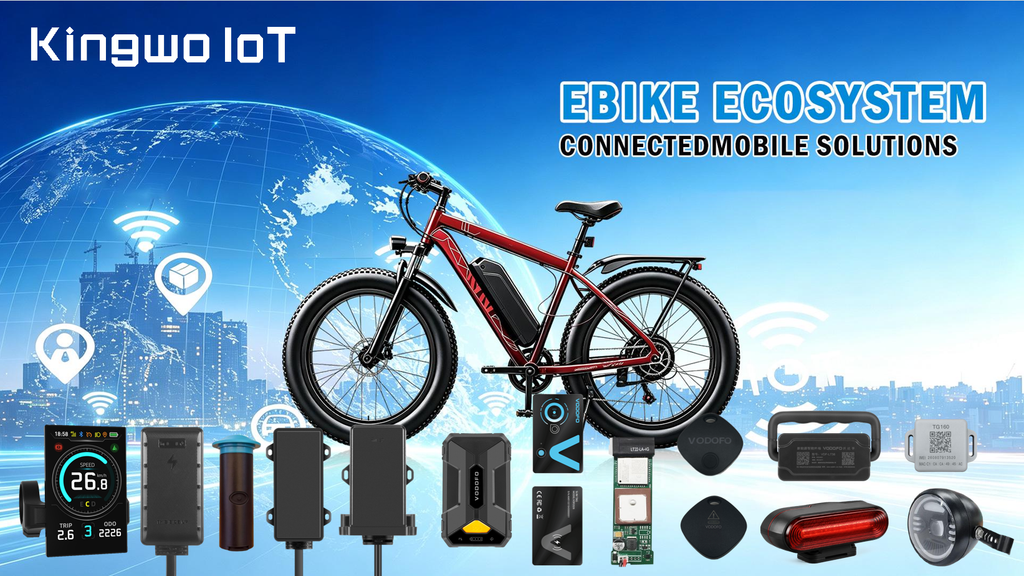
At Kingwo IoT, we believe that an IoT terminal installed in an electric bicycle should not be treated simply as a hidden hardware component. It should form part of the operator’s wider governance infrastructure.
For shared e-bikes and electric two-wheelers, that infrastructure may include real-time location reporting, configurable geofences, Bluetooth unlocking, vehicle-status monitoring, abnormal-movement alerts, remote configuration and over-the-air firmware updates. Flexible communication protocols and private-server connectivity can also allow operators to integrate terminal data into their own platforms and establish management rules that reflect local regulations and operational models.
IoT technology alone cannot solve every problem facing shared mobility. Cities still need sufficient parking facilities, users need clearer guidance, and operators must maintain effective on-the-ground teams. Cooperation between businesses, transport authorities and local communities will remain essential.
However, reliable IoT infrastructure gives operators the visibility required to respond before a misplaced or disconnected vehicle becomes a public obstruction. It connects technical data with operational responsibility and allows management teams to understand what is happening across the fleet in real time.
The seizure of 3,393 shared e-bikes in London should not be dismissed as a temporary parking dispute. It is an early indication of the standards that connected-mobility companies will increasingly be expected to meet.
As shared fleets become larger and more deeply integrated into public transport systems, companies will be judged not only by how many vehicles they connect, but also by how securely and responsibly those vehicles are managed. Regulators, city authorities and the public will expect operators to identify every connected asset, maintain its software, protect its data, monitor its condition and respond when its presence creates a risk.
The maturity of an IoT operation is therefore not measured by the number of devices shown on a platform. It is measured by whether the company can trust those devices, understand the information they provide and turn that information into timely operational action.
Connectivity created the opportunity for shared mobility to scale. Governance will determine which operators are capable of remaining on the road.
By Kailiang Tang
Acting Marketing Director, Kingwo IoT
 news
news
 news
news
 news
news
 news
news
 news
news
 news
news
 news
news
 news
news

English

French

Portuguese

Spanish