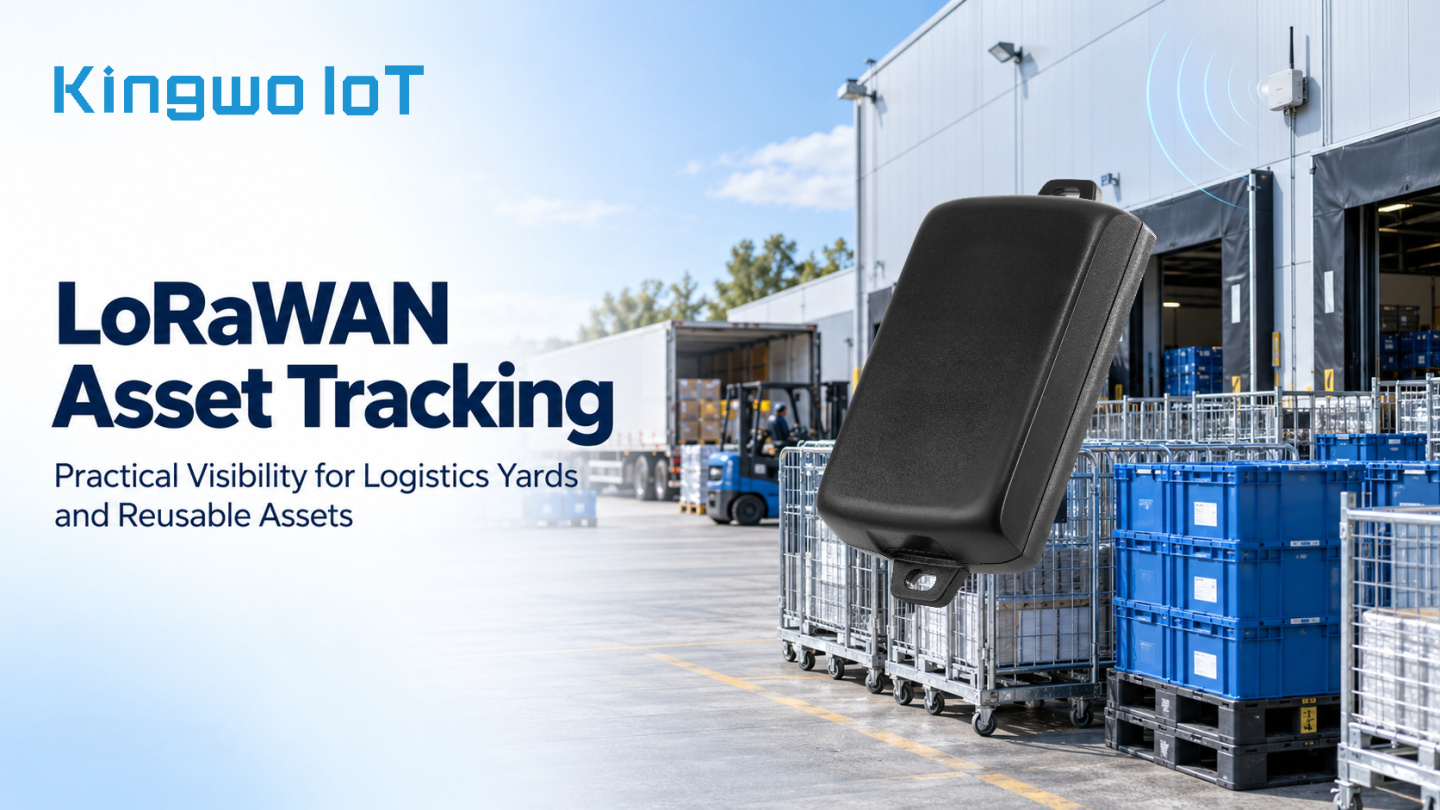

An industry perspective from Kingwo IoT
Transport racks, roll cages and reusable containers keep goods moving between suppliers, distribution centres and customer sites. Once unloaded, however, these assets can become hard to track. Incomplete movement records leave operations teams searching for equipment, arranging collections and purchasing replacements while usable assets remain elsewhere in the network.
LoRaWAN offers a connectivity option for monitoring battery-powered assets, particularly where reporting requirements and network coverage can be planned around defined operating areas. This article examines the practical considerations behind such deployments: battery maintenance, gateway coverage, location interpretation and pilot evaluation. Kingwo IoT’s RT67 LoRaWAN GPS tracker is referenced as a product example; no independent performance evaluation is provided.
A delivery can arrive on time while the equipment supporting it falls out of view.
After goods are unloaded, a transport rack may remain at a customer site awaiting collection. A reusable container may move to another warehouse without an updated record. Shared equipment may be relocated within a logistics yard while the inventory system continues to show its previous assignment.
These situations create uncertainty about what is available and where it can be collected. One facility may order additional equipment while another holds assets it no longer needs.
Tracking records can help address that uncertainty. Their value comes from supporting actions such as collecting overdue assets, reallocating available equipment and investigating unexpected movements. The LoRa Alliance identifies returnable assets, containers and intralogistics among the application areas for LoRaWAN. [1]
For logistics operators, the starting point is a clear understanding of the asset flow and the decisions that better information should support.
On September 22, 2026, the LoRa Alliance announced at The Things Conference in Amsterdam that LoRaWAN-connected devices had reached 150 million globally, with a reported compound annual growth rate of 25%.
The announcement covered utilities, buildings, industry and other sectors, including applications such as tracked pallets, smart padlocks and bicycles. These figures describe the wider LoRaWAN ecosystem rather than the asset-tracking market alone. [2]
The milestone provides context for the scale of the technology’s adoption. It does not establish that every logistics operation has suitable coverage or that every asset should use the same tracking approach.
For an individual project, suitability still depends on the operating environment, available network infrastructure, device capabilities and information requirements.
Many returnable assets have no permanent external power supply. Their tracking devices must operate independently while remaining practical to maintain.
A battery replacement may involve finding the asset, arranging access, removing the device and recording the work. When equipment circulates among multiple organizations, coordinating those steps can become a substantial task.
LoRaWAN’s low-power communication characteristics make it relevant to battery-operated applications. However, the service life of a complete tracker depends on more than the radio technology. Positioning activity, reporting frequency, signal conditions, temperature and battery capacity all affect energy consumption. [3]
The reporting strategy should therefore follow the operational task.
An asset parked at a depot may require occasional updates. Equipment moving through a dispatch area may need more frequent information. An unnecessarily demanding reporting schedule can increase maintenance requirements without giving staff information they can use.
Battery-life expectations should be assessed against the intended configuration and working conditions.
LoRaWAN devices communicate through compatible gateways, which use backhaul connectivity to reach a network server. Depending on availability and commercial arrangements, a deployment may use a public network or a private network managed by the business or a service provider. [3]
For a logistics project, coverage planning should include the locations where reports are expected: loading bays, storage areas, warehouse entrances, customer collection points and other regular stops.
Metal structures, stacked containers and device installation positions can affect communication. A test conducted in an open yard may not represent performance when the same device is mounted close to metal or surrounded by loaded equipment.
A useful site assessment should reflect normal operating conditions and likely changes in asset placement.
Assets travelling beyond the planned network footprint need separate consideration. Equipment circulating within one facility has different connectivity requirements from containers moving among distant customer sites. Reporting expectations outside confirmed coverage should be established before deployment.
A location record is useful when staff can judge what it tells them.
The time of the last report matters, as do the positioning method and expected reporting interval. A location received several hours earlier may support return planning but be insufficient for an immediate collection.
LoRaWAN provides the communication path. The way a system determines position depends on the device and the overall solution design.
This distinction should guide requirements. Confirming that a transport rack has reached a customer site may be sufficient for managing its return cycle. Finding a small item within a specific warehouse aisle may require a different positioning approach.
The interface should make the age and meaning of each record clear. Staff should be able to distinguish a recent position from a last-known location and understand when further checking is needed.
A pilot should begin with a specific task and a measurable baseline.
For returnable transport assets, the task might be identifying equipment that has remained at a customer site beyond an agreed period. For a logistics yard, it might be reducing the time needed to locate available equipment before dispatch.
Before installing devices, the business should record current search times, return-cycle durations or other relevant measures using existing records or direct observation.
The pilot should then cover representative assets, installation positions and working routes. Evaluation can include:
Reporting reliability should be measured against expected reporting opportunities within the agreed coverage area. Results should also be considered alongside changes in workload, asset mix and site conditions.
A short pilot may establish installation practicality and reporting behaviour, while longer-term maintenance and battery performance require continued observation.
Kingwo IoT lists the RT67 as a LoRaWAN GPS tracker for asset-monitoring applications. [4]
For a potential deployment, the configuration discussion should begin with the assets and their working routes: where they operate, how devices will be mounted, how frequently reports are needed and which network will carry the data.
These requirements help determine whether the proposed setup can provide useful information at an acceptable maintenance cost.
For logistics operators, distributors and system integrators, an RT67 pilot can be structured around a defined asset-management task, with coverage and reporting expectations agreed before installation. Product suitability and configuration should then be assessed against the results.
For reusable logistics assets, a well-planned tracking system can give teams a more dependable basis for collection, allocation and exception management.
Achieving that outcome requires attention to the complete deployment: device installation, battery use, network coverage, reporting behaviour and the way staff interpret the information.
Kingwo IoT welcomes discussions with businesses evaluating LoRaWAN asset tracking for logistics yards, equipment depots and reusable transport fleets. A focused assessment can establish the information required, the infrastructure available and the operational measures a pilot should test.
[1] LoRa Alliance. (n.d.). LoRaWAN® for smart logistics.
https://lora-alliance.org/logistics-vertical-market/
[2] LoRa Alliance. (2026, September 22). LoRa Alliance® reports 150 million LoRaWAN® devices deployed globally.
https://lora-alliance.org/category/lora-alliance-press-release/
[3] LoRa Alliance. (n.d.). About LoRaWAN®.
https://lora-alliance.org/about-lorawan/
[4] Kingwo IoT. (n.d.). RT67: LoRaWAN GPS tracker.
https://www.kingwoiot.com/product/lorawan-gps-tracker/
By Kailiang Tang
Acting Marketing Director, Kingwo IoT
 news
 news
 news
 news
 news
 news
 news
 news

English

French

Portuguese

Spanish